
What is Adaptive Artificial Intelligence?
Adaptive AI is a system that learns and updates its code in real-time as new data arrives. Unlike traditional 'frozen' models, it uses continuous feedback loops to adjust its logic autonomously, preventing model drift and maintaining peak performance in dynamic market conditions.
Static software is dead. The era of living code has begun.
Adaptive artificial intelligence is a system that learns and updates its own code in real-time as data flows in. Unlike static models that freeze after training, these systems use continuous feedback loops to adjust parameters without manual redeploys. This keeps the logic accurate even as market conditions shift. It solves model drift. For good.
In 2026, the transition from static to adaptive systems is the primary driver of ROI for enterprise automation. Static models are liabilities in dynamic markets because they begin to decay the moment they are deployed. By shifting to autonomous learning, high-growth B2B SaaS teams and global logistics firms can maintain peak performance in environments like high-frequency trading, supply chain logistics, and personalized e-commerce.
- The core principles of online learning and liquid neural networks
- Architecture gaps between traditional and adaptive AI models
- Technical mechanics: Reinforcement Learning and Bayesian updates
- Real-world industry applications from logistics to finance
- A 10-step implementation roadmap for autonomous deployment
- Critical risk assessment and ethical guardrail strategies
What is Adaptive AI? Core Principles and Definitions
Adaptive artificial intelligence is a framework that prioritizes continuous learning over batch training. It functions by treating every interaction as a potential data point for refinement. While a standard GPT-4o or Claude 3.5 instance knows only what was in its training set, an adaptive model can integrate new facts, user preferences, and sudden inventory drops into its active weights or its retrieval-augmented generation (RAG) context in seconds.
The core principle of this technology is the "online learning" framework. In this setup, the model does not wait for a developer to initiate a new training run on a massive GPU cluster. Instead, it uses streaming data pipelines to perform incremental updates. This creates a system that is fundamentally resilient to "black swan" events or sudden shifts in consumer behavior. It is the difference between a map that was printed last year and a live GPS that updates based on current traffic.
This form of intelligence is not just about updating a database. It is about architectural flexibility. It involves the use of dynamic neural networks that can prune or grow connections based on the complexity of the task at hand. In 2026, we see this most often in "liquid" neural networks, which use differential equations to model data as a continuous flow rather than discrete snapshots.
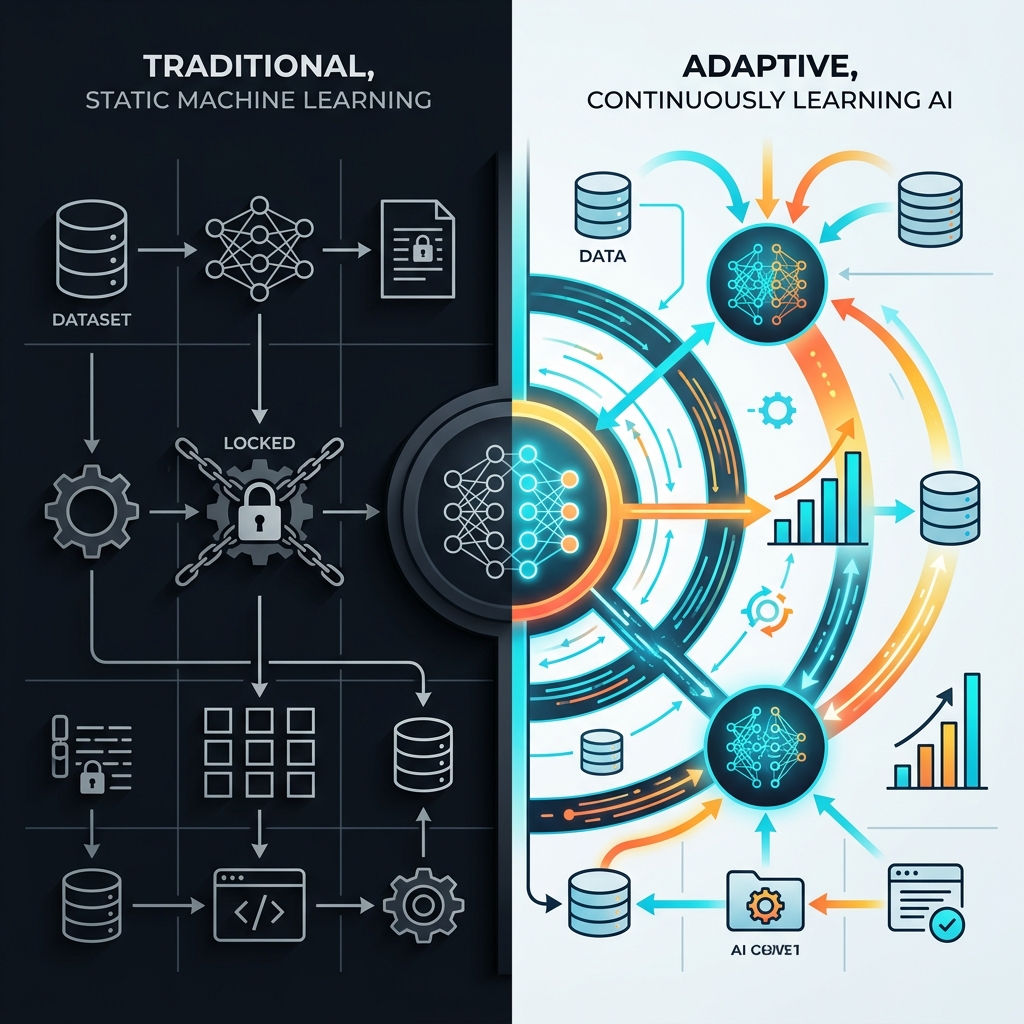
Traditional AI vs. Adaptive Models: The Architecture Gap
Traditional AI models follow a "train-then-deploy" cycle. You gather data, train the model, test it, and push it to production. Once it is live, its knowledge is fixed. If the underlying data patterns change, the model becomes less accurate. This is known as "data drift." In a static world, this is fine. In 2026, where market conditions change hourly, it is a significant risk.
Adaptive artificial intelligence uses a "stream-and-evolve" architecture. It processes data as it arrives, evaluates its own performance against pre-defined success metrics, and applies small, surgical updates to its logic. This requires a much more sophisticated MLOps stack, including real-time monitoring and automated guardrails to prevent the model from learning "garbage" data.
| Feature | Traditional AI | Adaptive AI |
|---|---|---|
| Training Cycle | Batch (Monthly/Quarterly) | Continuous (Real-time) |
| Data Recency | Fixed at training cutoff | Real-time streams |
| Model Drift | High risk; requires manual fix | Low risk; self-correcting |
| Compute Cost | High bursts during training | Low, consistent background load |
| Maintenance | Heavy manual intervention | Automated orchestration |
| Scalability | Linear | Exponential optimization |
According to Gartner (2025): "Organizations using adaptive AI will outperform their peers by 25% in operational efficiency by the end of 2026."
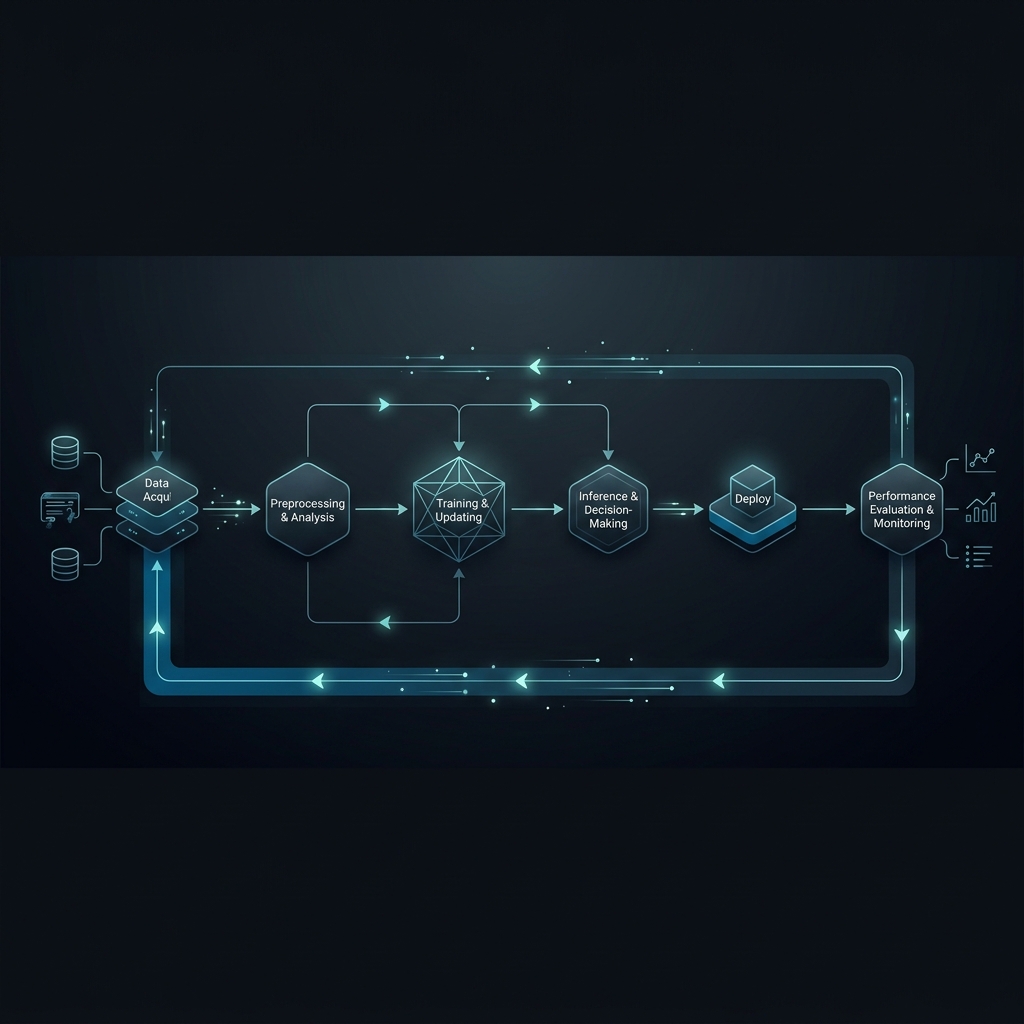
Technical Mechanics: How Adaptive Systems Learn in Real-Time
The technical foundation of adaptive artificial intelligence rests on three pillars: Reinforcement Learning (RL), Evolutionary Computation, and Bayesian updates. These methods allow a model to explore new strategies and commit to the ones that work.
Key Takeaways
- Unlike fine-tuning, adaptation is a constant, streaming state that never stops.
- Reinforcement learning drives the 'reward function' for autonomous optimization.
- Bayesian updates provide mathematical humility, preventing overreaction to data noise.
Reinforcement Learning and Feedback Loops
Reinforcement learning is the primary engine for adaptation. The system is given a "reward function" that defines success. As the AI takes actions, it receives a reward score. If the score is high, it reinforces that behavior. If the score is low, it tries something else. In an adaptive setup, this loop happens constantly in production.
For example, an adaptive pricing agent for a travel site might test different price points for a hotel room. If a slight increase in price leads to a higher conversion rate than expected, the agent immediately updates its pricing logic for similar rooms. It does not wait for a weekly report. This is often implemented using Q-Learning or SARSA (State-Action-Reward-State-Action) algorithms that maintain a live table of expected rewards for every possible action in a given state.
Reservoir Computing and Liquid Networks
In 2026, autonomous robotics teams use reservoir computing. This is a framework where a "reservoir" of fixed, randomly connected neurons processes input signals. Only the output layer is trained. This makes the system incredibly fast to update because you are only changing a small fraction of the total weights.
Liquid neural networks take this further. They use time-continuous parameters that allow the model to adapt to the "speed" of the data. If the data starts arriving faster or becomes more volatile, the liquid network adjusts its internal time constants to match. This is the gold standard for high-frequency environments like algorithmic trading or autonomous drone flight.
Bayesian Online Learning
Bayesian updates allow the AI to maintain a "probability distribution" over its own knowledge. Instead of being 100% sure about a fact, the AI says, "I am 85% sure this is the best route." As new data arrives, it uses Bayes' Theorem to update that percentage. This prevents the model from overreacting to outliers or noise in the data stream. It provides a level of mathematical humility that is missing from traditional deep learning models.
Conceptual Online Update Loop
def adaptive_update_loop(live_data_stream, model, reward_function):
    for event in live_data_stream:
        # Predict or take action
        action = model.predict(event.features)

        # Observe result in the real world
        actual_outcome = observe_outcome(action)

        # Calculate reward based on business goals
        reward = reward_function.calculate(actual_outcome)

        # Perform incremental weight update (Online Learning)
        # Instead of full retraining, we adjust weights slightly
        model.incremental_train(event.features, reward)

        # Log for observability and guardrail checks
        log_performance(model.version, reward)
By using these methods, an adaptive ai development company can build systems that actually get smarter the more they are used. At UseShift, we implement these loops so that our custom agents don't just follow instructions; they optimize for the specific outcomes our clients need.
How Search Engines and LLMs Handle Adaptive Content
Search engines like Google are evolving to better understand adaptive content. In the past, Googlebot preferred static pages that didn't change every time a crawler visited. However, with the rise of AI-driven personalization, the search environment is shifting toward "intent-based" indexability.
Google's current algorithms are focused on the "Helpful Content" system. If your autonomous learning system is generating real-time updates that provide genuine value to the user, you will be rewarded. However, if the adaptation leads to thin, generic, or wildly inconsistent content, your rankings will suffer. The key is to maintain a stable "canonical" version of your pages while using the adaptive layer to personalize the user experience once they land on the site.
LLMs used for search (like Perplexity or OpenAI Search) prefer adaptive sources because they can provide the most current data. By having a dynamic backend, your site becomes a more authoritative source for these "Answer Engines." This is a core part of modern developing artificial intelligence strategies. We call this "Source Freshness Optimization." It ensures that when an LLM looks for data, your adaptive system provides a version that is seconds old, not months old.
Real-World Applications in 2026
The impact of this technology is most visible in industries where the cost of being "wrong for an hour" is high.
1. Dynamic Supply Chain Orchestration
Traditional logistics systems use historical data to predict future needs. In 2026, an adaptive logistics AI system monitors live port congestion, social media trends that might trigger a demand spike, and even weather patterns that affect delivery speeds. If a port in Singapore slows down by 15% (according to 2026 maritime industry benchmarks), the system immediately reroutes ships in the Atlantic. It doesn't wait for a manager to approve the change.
2. Hyper-Personalized Retail
Static recommendation engines show you "what people like you bought." Adaptive AI shows you "what you need right now based on your current context." If you just entered a high-end gym, the adaptive system in a retail app might highlight performance supplements or high-compression gear. It learns from your immediate movement data and recent purchases to provide a "market of one" experience.
3. Real-Time Compliance and Auditing
In the financial sector, AI and auditing have moved from annual checks to millisecond-level oversight. Adaptive agents monitor every transaction as it happens. If a new type of shell company structure appears in a global database, the agent immediately learns the signature and flags similar patterns in the local ledger. This makes manual, retroactive auditing obsolete.

The Business Value of Adaptive AI Development
The business case for adaptive systems is built on resilience. In traditional software, you have a fixed cost to build and a variable cost to maintain. In AI, you have a massive upfront cost to train and a hidden, growing cost of "staleness." Adaptive systems flip this model. They require a higher initial investment in infrastructure but have a much lower long-term cost of error.
Inventory Waste Reduction
40% reduction in waste compared to static forecasting (MIT Sloan 2025).
Speed of Response
Shifts from weeks of retraining to seconds of adaptation.
Profit Margin Protection
Maintains peak performance in volatile markets automatically.
Another factor is the "Speed of Response." In 2026, the first company to adapt to a market shift wins. Static AI requires a human to see the shift, a developer to find new data, a scientist to retrain the model, and a DevOps engineer to redeploy it. This takes weeks. Adaptive AI takes seconds. That time difference is the profit margin.
Implementation Guide: Deploying Adaptive Artificial Intelligence
Deploying an adaptive artificial intelligence system is more complex than a standard SaaS launch. It requires a shift from "Project Thinking" to "Pipeline Thinking." Here is a 10-step guide to doing it right.
Define Success Metrics
Define a clear, mathematical reward function (e.g., booked meetings or fuel reduction).
Data Pipeline Orchestration
Use stream processing (Kafka/PubSub) and vector databases for high-velocity context.
Model Selection
Decide between RL agents (actions) or online learning (predictions). Use actor-critic for speed.
Guardrails and Safety
Implement hard code constraints that the AI cannot override. Use Sandboxed Adaptation.
Observability
Setup dashboards for confidence scores and drift metrics. Use Anomalous Learning alerts.
Deployment Strategies
Use Shadow deployments (passive) followed by Canary rollouts (active).
Iterative Scaling
Start with a single low-risk feedback loop before moving to high-risk areas.
Feedback Quality Filtering
Filter signals based on statistical significance and source reliability.
Version Control
Version weights as well as code. Support "Time Travel" rollbacks for compliance.
Human Oversight (HITL)
Review reasoning logs initially to ensure alignment with ethics and brand value.
Risk Assessment & Ethics: The Black Box Problem
The biggest risk with this type of technology is the loss of predictability. In a static system, you can test a specific input and always get the same output. In an adaptive system, the model might behave differently on Tuesday than it did on Monday because it learned something new in between.
WARNING: Feedback Loop Collapse
If an adaptive system is trained on its own output without sufficient external "ground truth" data, it can enter a state of model collapse. It begins to amplify its own biases and errors until the system becomes useless. Maintain at least 20% of your training data from verified human sources or objective real-world outcomes.
Another risk is "Data Poisoning." If a malicious actor understands your feedback loop, they can feed the system specific data designed to "teach" it bad habits. This is a major concern for AI and auditing where security is paramount. We solve this by using "Weight Sanitization" protocols that filter out extreme updates that don't align with historical performance.
Selecting an Adaptive AI Development Company
Building these systems in-house is difficult. It requires a mix of data scientists, MLOps engineers, and specialized software architects. When looking for an adaptive ai development company, don't just ask about their models. Ask about their infrastructure.
PRO TIP: Evaluate the MLOps Stack First
When vetting a partner, ask to see their observability dashboard for a live project. If they can't show you real-time drift metrics and update logs, they are likely just building static models and calling them "adaptive." True autonomy requires transparent monitoring.
At UseShift, we specialize in building these autonomous learning systems for B2B enterprises. We don't just deploy a bot; we build the entire orchestration layer that allows your AI to evolve alongside your business. You can learn more about our approach in our AI consulting firms guide. We prioritize "Systemic Safety," ensuring that as your AI learns, it remains aligned with your core business values.
Conclusion
The era of "static" software is ending. In a world defined by rapid change, the only way to maintain a competitive advantage is to build systems that learn as fast as the market moves. This shift is not just a technical upgrade; it is a fundamental shift in how businesses operate. It marks the end of software that starts dying the moment it is finished.
By implementing these autonomous learning systems, you eliminate the manual overhead of constant model maintenance while keeping your automation accurate 24/7. Whether you are looking to optimize your supply chain or build a hyper-personalized customer experience, the move to adaptive systems is the most effective way to drive long-term AI ROI. It turns your software from a cost center into a self-improving asset.
It is time to build software that lives.
Key Takeaways
- Adaptive AI solves model drift by enabling real-time autonomous updates.
- The ROI comes from resilience and the ability to adapt to market shifts in seconds.
- Success requires strict reward functions, robust MLOps, and hard safety guardrails.