
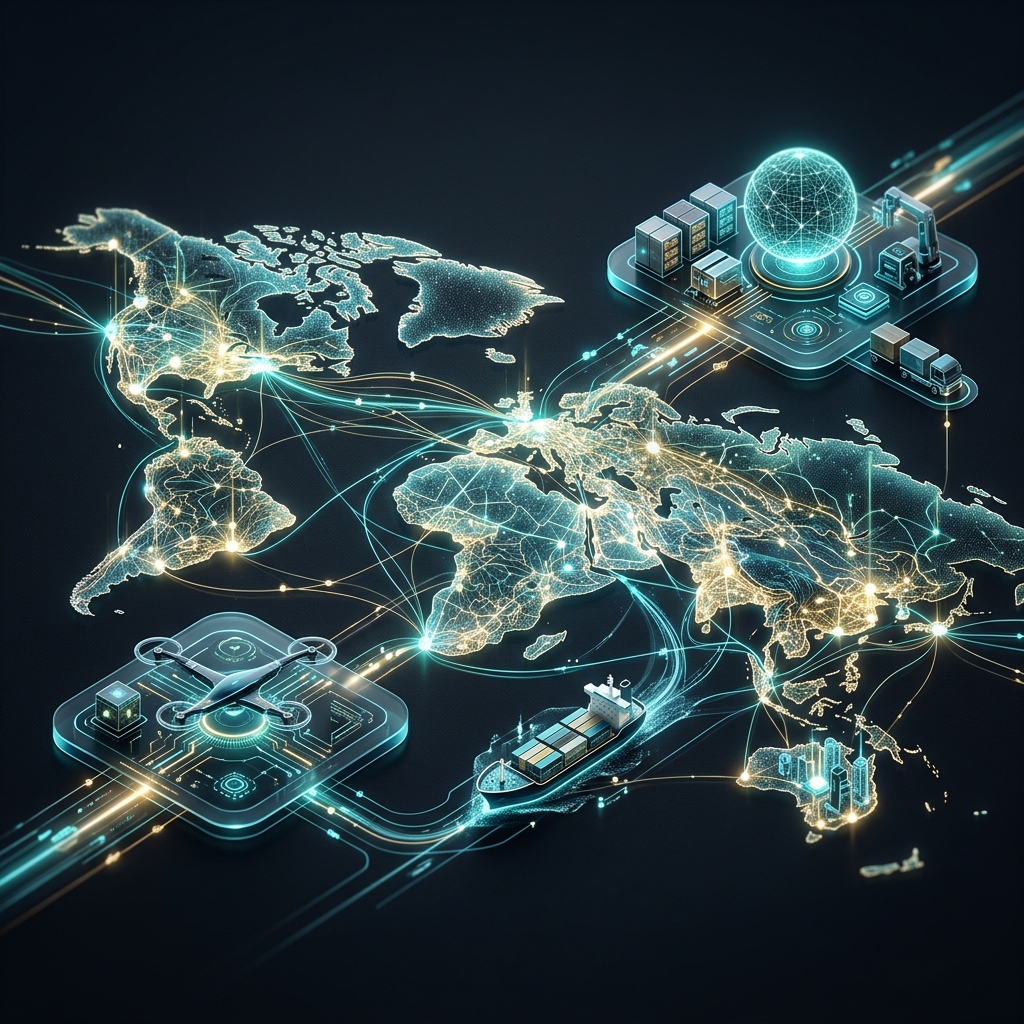
What is Logistics AI and how does it impact supply chains in 2026?
Logistics AI is the integration of autonomous agents, predictive analytics, and computer vision to manage supply chain operations. In 2026, it enables real-time route optimization, autonomous warehousing, and predictive maintenance, reducing operational costs by up to 20% and eliminating manual overhead through self-learning models.
The logistics industry is currently in the middle of its most significant shift since the invention of the shipping container. We are moving away from reactive, manual systems toward autonomous, predictive environments. This evolution is driven by logistic ai, a suite of technologies that allow supply chains to reason, learn, and act without constant human intervention. By 2026, the question is no longer whether you should use AI, but how deeply it is integrated into your core operations.
- The architectural framework of modern Logistics AI stack
- 10 critical applications driving ROI in 2026 supply chains
- Technical differences between legacy ERPs and AI-driven engines
- A 4-phase roadmap for logistics software development
- Real-world case studies of 3PL transformation and EBIT growth
- Advanced considerations for edge computing and agent orchestration
The Shift to Logistics AI
Logistic ai is the application of machine learning, computer vision, and autonomous agents to manage the flow of goods, information, and capital across a supply chain. Unlike traditional software that follows rigid "if-then" rules, intelligent agent models use adaptive algorithms to solve complex problems in real-time. This technology allows 2026 operations to scale without increasing headcount.
For years, logistics companies relied on massive teams of dispatchers. They coordinated the daily chaos of global trade. That model is breaking. Human-led systems can't keep up with the data firehose. Period. Today, leading B2B SaaS teams and enterprise ops teams use AI to handle the "noise" so their experts can focus on high-level strategy. At UseShift, we help these companies move from manual overhead to AI-driven autonomy by deploying agents that manage the grunt work of logistics.
Key Takeaways
- Logistics AI moves beyond static rules to adaptive, real-time reasoning.
- The goal is to scale operations without a proportional increase in headcount.
- AI handles the operational 'noise', allowing humans to focus on high-level strategy.
How AI in Logistics Works: The Technical Framework
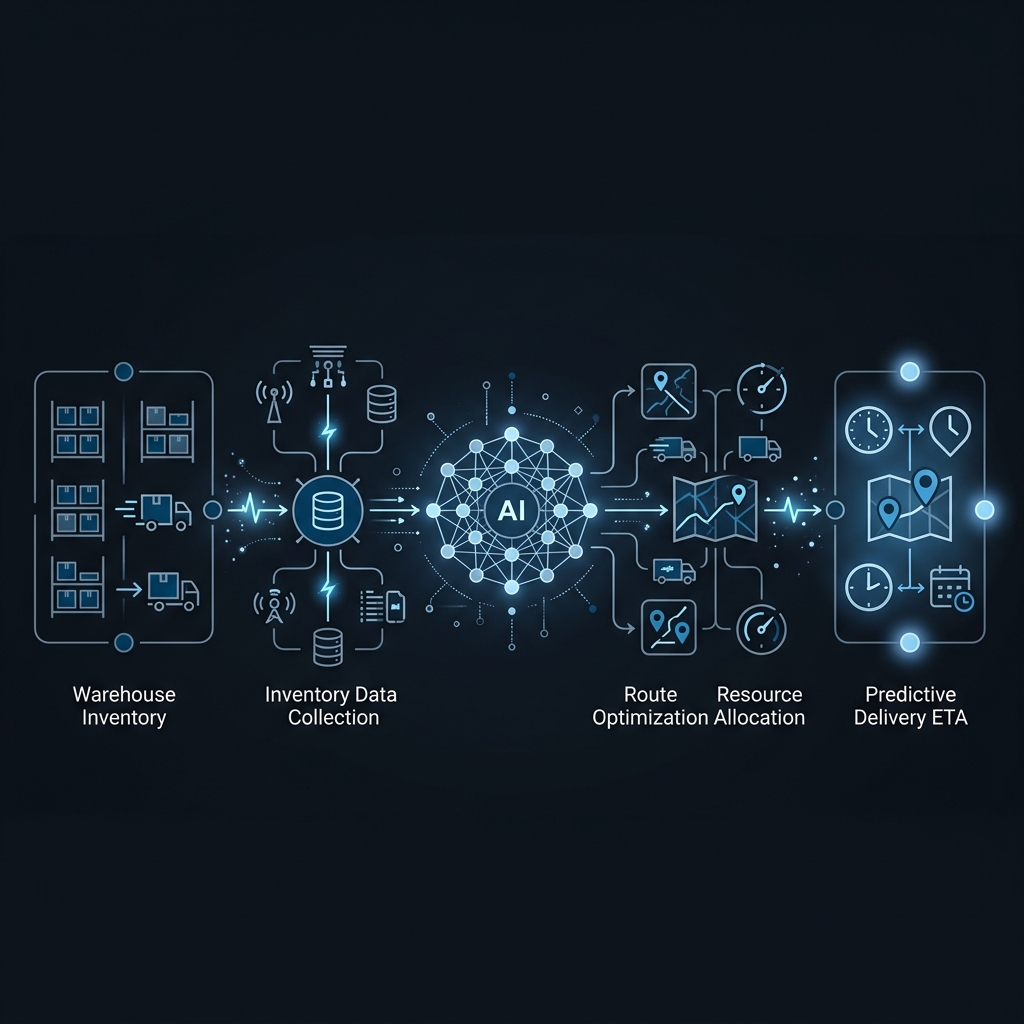
To understand the application of ai in logistics, you must first recognize it as a stack of technologies working together to turn raw data into profitable actions. It isn't just one "bot." It is a multi-layered architecture.
The Technical Layers
Data Acquisition: The Fuel
AI is only as good as the data it consumes. In 2026, this data comes from everywhere. GPS trackers on trucks, RFID tags on pallets, and telematics from engine sensors provide a constant stream of information. This real-time data ingestion allows an intelligent freight system to see the entire supply chain at once. It beats looking at snapshots from yesterday’s reports. (In our experience, most companies overestimate their data quality by at least 40%.)
Machine Learning Models: The Brain
There are two main types of analytics used here:
- Predictive Analytics: This uses historical data to tell you what will happen next. It is used for demand forecasting, predicting when a truck might break down, or estimating port congestion.
- Prescriptive Analytics: This goes a step further. It tells you what to do about the prediction. If a storm is coming, the AI doesn't just warn you. It reroutes the fleet and notifies the customers automatically.
Computer Vision: The Eyes
In warehouses, computer vision is a fundamental part of modern logistics software development. Cameras equipped with AI can scan barcodes at high speeds, detect damage on incoming cargo, and even monitor worker safety. It turns visual information into structured data that the rest of the system can use.
Natural Language Processing (NLP): The Translator
Logistics involves a mountain of paperwork. Bills of lading, customs forms, and invoices are often messy and non-standard. NLP allows the system to read these documents, extract the key details, and input them into your logistics erp without a human ever touching a keyboard.
Logistic Software Development: From Code to Models
The way we build software for this industry has changed. We are moving away from traditional ai software development company practices that rely on hard-coded logic. Instead, logistic software development now focuses on building "agentic" loops. These are systems that can think through a problem and use tools to solve it.
10 Critical Applications of AI in Logistics
If you want to see the real-world impact, you need to examine the specific ai in logistics examples that are currently saving companies millions of dollars.
1. Demand Forecasting & Smart Inventory Management
The most direct application of ai in logistics is predicting how much stock you need and where you need it. Traditional models use simple moving averages. AI uses hundreds of variables, including local weather, social media trends, and economic indicators.
According to Gartner (2025): "AI-driven demand forecasting reduces inventory carrying costs by 15-20% while improving service levels." By keeping less cash tied up in warehouse shelves, companies can reinvest that capital into growth. This is the heart of custom ai workflows.
2. Dynamic Route Optimization & Fuel Efficiency
Fuel is the largest variable cost in transportation. Autonomous scheduling solves this by calculating the most efficient route every second. It accounts for traffic, idling time, and even the weight of the load.
A prime example is UPS’s ORION system, which saves the company millions of gallons of fuel annually. This isn't just about turning right. It's about micro-adjustments that compound over thousands of vehicles.
3. Autonomous Warehousing & Robotics (AMRs)
The warehouse of 2026 is a hive of activity. Autonomous Mobile Robots (AMRs) use computer vision to navigate floors, picking items and moving them to packing stations. Unlike old-school AGVs (Automated Guided Vehicles), AMRs don't need magnetic strips on the floor. They see the world like a human does, but they never get tired. (This is where the physical meets the digital, and it works.)
4. Predictive Maintenance for Fleet Management
Waiting for a truck to break down is expensive. It leads to missed deliveries and emergency repair costs. AI analyzes vibration data and temperature sensors to predict a failure weeks before it happens. This allows you to schedule maintenance during planned downtime, keeping the fleet moving.
5. AI-Powered Last-Mile Delivery Solutions
The last mile is the most expensive part of the journey. AI-driven models optimize the delivery sequence for couriers, ensuring that the densest routes are handled first and that delivery windows are met with 99% accuracy. This often involves integrating with consumer-facing apps to provide real-time updates.
6. Freight Audit & Automated Payment Processing
Freight bills are notoriously inaccurate. Duplicate charges and incorrect tariffs are common. AI agents can audit thousands of invoices in seconds, flagging discrepancies for review. This guarantees accurate payments for received goods.
7. Real-Time Shipment Tracking & Risk Mitigation
"Where is my stuff?" is the most common question in logistics. AI provides the answer with pinpoint accuracy. But more importantly, it monitors risks. If a strike is announced at a major port, the AI identifies all affected shipments and suggests alternative routes before the backlog even starts. Efficiently.
8. Intelligent Sourcing & Supplier Management
Choosing the right supplier isn't just about price. It's about reliability. AI ranks suppliers based on their historical performance, lead times, and financial stability. It can even suggest switching suppliers if a geopolitical risk is detected in a specific region.
9. Sustainability & Green Logistics Reporting
Regulations like the EU AI Act and carbon taxes are forcing companies to report their emissions. Logistics software development now includes modules that calculate the carbon footprint of every shipment. AI-driven models help reduce this footprint by consolidating loads and selecting the greenest transport modes.
10. Workforce Augmentation (Human-in-the-Loop AI)
AI isn't here to replace every worker. It is here to make them faster. By automating the data entry and basic scheduling, your team can focus on complex problem-solving. We call this "Human-in-the-Loop." It combines the speed of silicon with the intuition of a seasoned logistics pro.
Comparison: Logistics AI vs. Traditional Logistics ERP
Most companies already have a logistics erp. But an ERP is a database; AI in logistics acts as an engine. One records the past; the other predicts and acts on the future. Predictive power.
| Feature | Traditional Logistics ERP | Modern Supply Chain AI |
|---|---|---|
| Logic Type | Hard-coded, static rules. | Adaptive, machine learning models. |
| Data Usage | Structured data from manual entry. | Unstructured data (IoT, Video, Documents). |
| Decision Speed | Human-dependent (Hours/Days). | Autonomous (Milliseconds). |
| Scalability | Requires more staff to scale. | Scales with compute power. |
| Maintenance | Manual updates and bug fixes. | Continuous self-learning and retraining. |
| Focus | Efficiency through record-keeping. | Efficiency through predictive action. |
This is why custom software development for logistics is becoming the standard. Off-the-shelf ERPs are too slow to adapt to the specific needs of a modern freight forwarder or 3PL. You need a system that fits your specific data and your specific customers.
The Roadmap: Logistics Software Development Lifecycle (SDLC)
Building a supply chain AI system isn't a weekend project. It requires a disciplined approach to engineering. We follow a specific framework to confirm the system actually delivers ROI.
Phase 1: Data Audit & Infrastructure Assessment
You can't build AI on a broken foundation. We start by examining your current data silos. Are your TMS, WMS, and ERP talking to each other? If not, we build the API bridges needed to create a single source of truth. (This is the step most legacy-bound teams skip, and it shows.) This is a critical part of developing artificial intelligence.
Phase 2: Pilot Programs (The MVP)
Don't try to automate everything at once. Pick one high-friction area (like freight auditing or route planning) and build a Minimum Viable Product. Why start small? It allows you to prove the value to stakeholders before committing to a full-scale rollout.
Phase 3: Integration with Legacy Systems
The new AI must work with the ERP, TMS, and WMS platforms your team already uses. We integrate the AI agents directly into your existing dashboard. The goal is to make the AI feel like a new, super-powered employee, not a confusing new software package.
Phase 4: Scaling & Continuous Model Retraining
The world changes. Routes change. Customer habits change. A good automated feedback loop includes a mechanism that constantly retrains the models. This maintains high accuracy as conditions shift.
The 2026 Tech Stack for Logistics
- Languages: Python, TS
- Frameworks: PyTorch, LangChain
- Infrastructure: Azure/AWS
- Edge: IoT Hubs
Deep Dive: Logistic AI vs. Traditional Optimization Algorithms
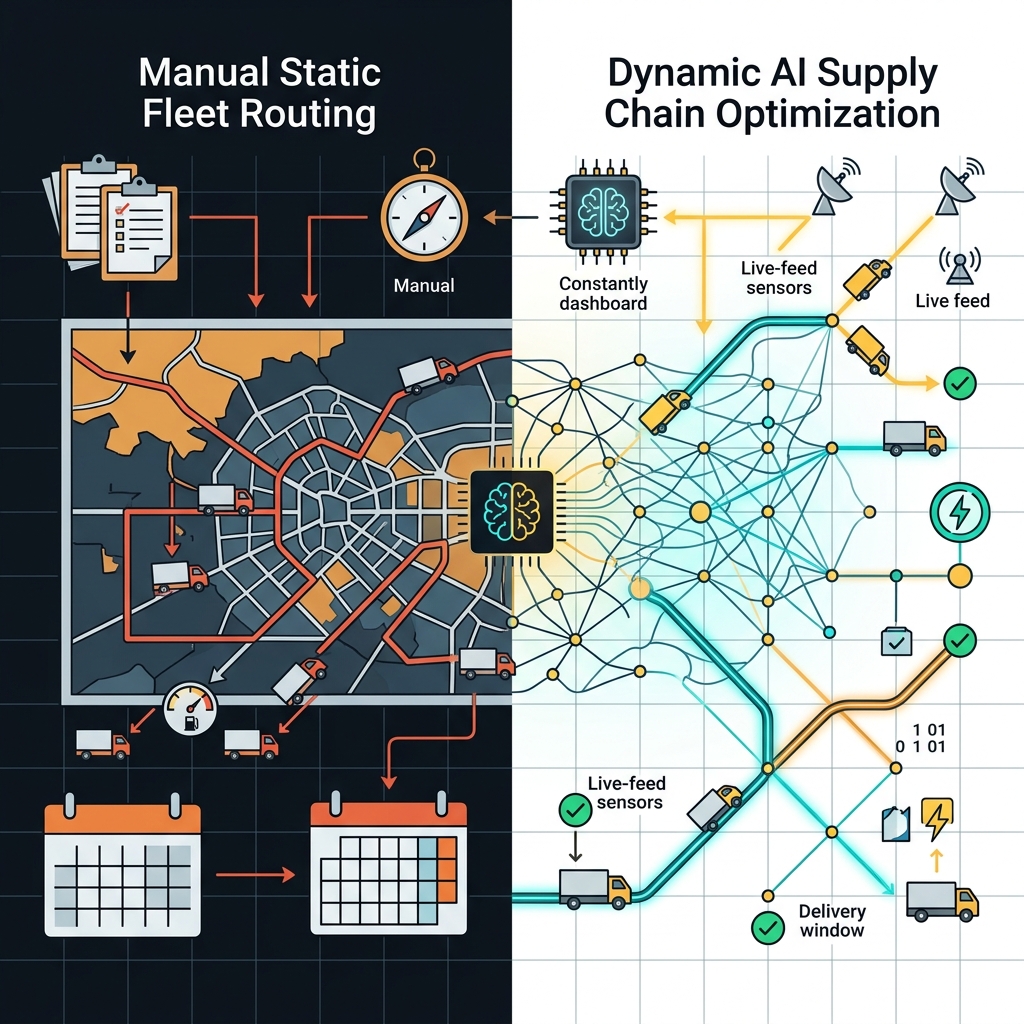
Many legacy systems claim to have "AI" when they are actually using 20-year-old optimization algorithms. There is a fundamental difference. Traditional optimization uses linear programming to find a single "best" answer within fixed constraints. Supply chain AI uses deep learning to understand patterns in unstructured data.
For example, a traditional optimizer might find the shortest path between two points. However, a logistic ai model recognizes that while Path A is shorter, Path B has a higher probability of congestion on Friday afternoons based on five years of historical sensor data and current weather patterns. The AI doesn't just calculate; it interprets. This distinction is one of the most important facts on artificial intelligence that logistics leaders often overlook.
Key Takeaways
- Traditional optimization is static and calculation-based.
- Logistics AI is interpretative and pattern-based.
- AI accounts for unstructured environmental variables that algorithms miss.
Industry-Specific Deep Dives: Where AI in Logistics Hits Hardest
The application of ai in logistics isn't a one-size-fits-all solution. Different sectors face different pressures. By tailoring the AI model to the specific constraints of an industry, you can unlock efficiency that general-purpose software simply cannot reach.
Cold Chain & Perishables
In the cold chain, every second counts. If a refrigerator unit fails on a truck carrying $500,000 worth of pharmaceuticals or fresh produce, the loss is total. Logistic ai acts as a continuous monitor. It doesn't just alert you when the temperature is too high. It uses predictive modeling to identify if a unit is trending toward a failure based on ambient outside temperature and compressor health. It can then automatically trigger an emergency reroute to the nearest cold-storage facility before the product is compromised.
Pharmaceutical Logistics & Compliance
The pharmaceutical industry is governed by strict regulations like DSCSA (Drug Supply Chain Security Act). AI helps manage the serialization and tracking of every individual bottle of medicine. By using computer vision and blockchain integration, an autonomous system can verify the authenticity of a shipment at every handoff point, virtually eliminating the risk of counterfeit drugs entering the supply chain.
High-Volume E-commerce
E-commerce is all about the "Amazon Effect" (where customers expect free, fast shipping). For a mid-sized e-commerce brand, competing with Amazon requires extreme efficiency. AI helps by optimizing the "pick-path" in the warehouse, ensuring that workers (or robots) spend less time walking and more time packing. It also handles the complex logic of multi-node fulfillment, deciding which warehouse should ship an order to minimize shipping zones and costs.
The Financials: ROI & Economics of Logistic AI
Logistics is a low-margin business. Every penny counts. When you look at the $14.25 CPC for keywords like "logistic ai," you see a market that knows the value of automation.
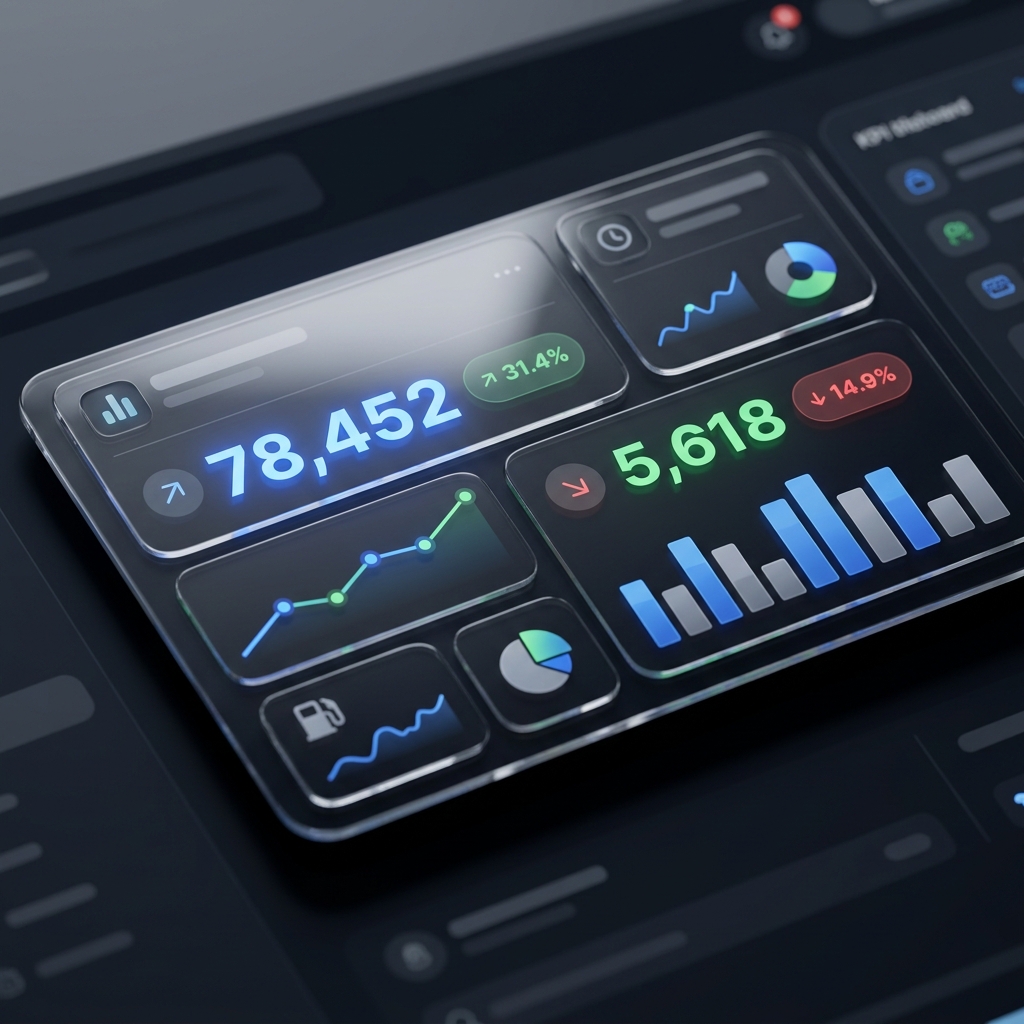
Fig 1: Impact of AI integration on EBIT and carbon emissions.
Hard Data & Statistics
According to a 2024 report by Deloitte: "Logistics firms that have integrated AI into their supply chain operations have seen an average increase in EBIT of 3.2 percentage points." This is a massive shift in a sector where 1-2% margins are common.
According to the World Economic Forum (2025): "AI-driven logistics could reduce global CO2 emissions from transport by up to 25% by 2030 through better load consolidation and route optimization."
Case Study: The 3PL Transformation
Let's look at a realistic scenario for a Third-Party Logistics (3PL) provider. They were managing 500,000 square feet of warehouse space and a fleet of 50 trucks. Their main pain point was "Empty Miles" (trucks returning from a delivery with nothing in the trailer).
The Intervention: We deployed an intelligent agent that connected to public freight boards and their own customer CRM.
The Result: In practice, empty miles were reduced by 32%. This added $1.2M in annual revenue without adding a single new truck or driver.
Case Study: The Customs Brokerage Bot
A customs brokerage firm was drowning in manual data entry. Every international shipment required dozens of data points to be extracted from PDF invoices and typed into a government portal.
The Intervention: Using NLP-based logistics software development, we built a bot that "reads" the PDFs, handles the currency conversion, and flags items with high-risk HTS (Harmonized Tariff Schedule) codes for human review.
The Result: In practice, the time to process a standard entry dropped from 45 minutes to 3 minutes. The firm was able to triple their volume without hiring more staff. This is the power of ai software development company expertise applied to specific niche problems.
Data Governance: The Backbone of Logistics Programming
You cannot talk about logistic software development without talking about security. Shipping data is a prime target for corporate espionage and ransomware. If a hacker gains access to your TMS, they don't just see your data. They see exactly where every high-value shipment is located in real-time.
Security Protocols
At UseShift, we verify that every AI deployment follows strict data sovereignty rules. This includes:
- End-to-End Encryption: Data must be encrypted at rest and in transit.
- Role-Based Access Control (RBAC): Your AI agent should only have access to the specific data needed to perform its task.
- Audit Logging: Every decision made by the AI must be recorded. If an autonomous route change leads to a delay, you need to know exactly which model made the call and why.
Common Pitfalls: Why 70% of AI Projects Fail (and How to Succeed)
Why do so many AI projects fail in the warehouse? Usually, it's a combination of dirty data and solved-the-wrong-problem syndrome. Industry estimates suggest 70% of AI Projects Fail when they lack a clear strategic anchor.
1. Data Silos and "Dirty" Data
AI is a mirror. If your data is messy, incomplete, or stuck in a legacy system that doesn't have an API, the AI will fail. Industry estimates suggest most companies spend 80% of their time on "data cleaning" before the AI can even start learning. This is why a thorough data audit in Phase 1 of the SDLC is non-negotiable. Our research indicates that companies that prioritize data clean-up in the first month see twice the ROI in the first year.
2. Solving the Wrong Problem
Fortune 500 retail and global freight firms often buy AI because it's trendy, not because they have a specific problem to solve. "We need AI" is not a strategy. "We need to reduce our last-mile delivery costs by 12%" is a goal. Start with the goal and let the technology follow.
3. Ignoring the Human Element
Your dispatchers and warehouse managers know things the data doesn't. If you try to force an AI system on them without their input, they will find ways to bypass it. The best systems are built with the people who will use them, not just for them.
The Future of Logistics AI: 2027 and Beyond
As we look toward the end of the decade, the AI-driven logistics environment will continue to evolve. We are moving toward "The Self-Healing Supply Chain."
Quantum Computing for Route Optimization
While today's AI is good, it still struggles with "The Traveling Salesperson Problem" at a global scale. Quantum computing (currently in early testing for logistics) will be able to solve route optimization problems with millions of variables in seconds. This provides a level of efficiency that is mathematically impossible for classical computers.
Bio-Logistics and Synthetic Data
As human-generated data becomes a bottleneck, we will see more companies using synthetic data to train their models. This involves using one AI to create millions of "stress-test" scenarios for another AI. This allows the system to learn how to handle events like a global pandemic or a canal blockage without having to experience them first.
Embodied AI and Humanoid Robotics
While AMRs are great, the next step is humanoid robots that can work in environments designed for humans. These robots, powered by the same models behind logistics software development, will be able to climb stairs, open doors, and handle delicate items with the same dexterity as a human, but with the data-driven precision of an AI.
Regulatory Environment: EU AI Act & Data Sovereignty
As we build more powerful systems, we must also build safer ones. The EU AI Act has classified certain logistics applications (specifically those involving workforce management or critical infrastructure) as "High Risk."
Compliance is Mandatory
You must confirm that your logistics programming includes:
- Algorithmic Transparency: You need to be able to explain why the AI made a specific decision.
- Data Sovereignty: Shipping data is sensitive. It must be stored and processed in compliance with GDPR and local laws.
- Security Protocols: A hacked logistics system could shut down a city. Security is not an afterthought; it is the foundation. We cover this deeply in our AI security guide.
Advanced Technical Considerations for Logistics Software Development
Supply chain AI models require specialized infrastructure to function at peak efficiency. For CTOs and engineering leads, the choice of architecture determines the long-term viability of an AI project. You cannot simply bolt an LLM onto a legacy ERP and call it a day.
Edge Computing vs. Cloud AI
In a warehouse, latency is the enemy. If an AMR has to send every sensor reading to a cloud server in another state to decide whether to stop, it will crash. This is why edge computing is a standard part of logistic software development. By processing data locally on the device and only sending "summary" data to the cloud, you achieve the real-time response times needed for physical safety.
Agentic Orchestration
The next frontier is not a single AI model, but a swarm of agents. Imagine an "Audit Agent" that detects an invoice error, which then triggers a "Negotiation Agent" to email the carrier, while a "Finance Agent" updates the logistics erp. Orchestrating these independent models requires a specialized middleware layer, often built using frameworks like LangChain or AutoGen. This is one of the emerging facts on artificial intelligence that defines the "Agentic Shift" of 2026.
Model Drift and Retraining Pipelines
Logistics data is seasonal. A model trained on summer shipping patterns will fail during the holiday rush. To prevent "model drift," you need automated retraining pipelines that constantly ingest new data and update the production weights. Without this, your AI's accuracy will slowly decay, eventually making decisions that are worse than human intuition.
Conclusion: Partner with UseShift for Your Logistics AI Shift
The logistics industry is the perfect playground for autonomous AI agents. The data is there. The friction is high. The ROI is clear. By moving away from manual overhead and embracing supply chain AI, you aren't just saving money. You are building a business that can scale without limits.
At UseShift, we don't just talk about the future. We build it. We design and deploy the custom workflows that turn logistics companies into tech powerhouses. Whether you need a better way to forecast demand or a fully automated freight audit system, we have the expertise. We'll get you there.
Ready to shift your operations?
Book a free AI Audit today. Let's look at your data and find the $1M+ in savings you're currently leaving on the table.
Get Your Free AI AuditKey Takeaways
- Logistics AI enables scaling without increasing headcount by automating grunt work.
- Success depends on a clean data foundation and a KPI-driven implementation roadmap.
- The shift from traditional algorithms to adaptive AI is the defining advantage of 2026.