
What are pervasive technologies in 2026?
Pervasive technologies are computing systems that recede into the surroundings by being embedded in objects, furniture, and industrial machinery. They sense, communicate, and act autonomously without requiring active human input, enabling businesses to automate complex environments with zero cognitive load on operators.
The future of computing isn't on your screen—it's in your walls.
Pervasive technologies are computing systems that disappear into our surroundings. Unlike traditional computers that require our full attention, these systems are embedded in objects, furniture, clothing, and industrial machinery. They sense, communicate, and act without needing a "start" button. In 2026, we have finally reached the technical maturity to fulfill the vision of truly invisible automation.
- The historical shift from mainframes to ambient intelligence
- The three pillars: Ubiquitous Computing, AmI, and Edge Processing
- Hardware advancements closing the energy and connectivity gaps
- Real-world industry applications from Dark Factories to Precision Agriculture
- Strategic implementation frameworks for immediate ROI
- Privacy and ethical considerations in the age of invisible sensing
1. Introduction: The Age of Embedded Intelligence
Pervasive technologies are computing systems that disappear into our surroundings. Unlike traditional computers that require our full attention, these systems are embedded in objects, furniture, clothing, and industrial machinery. They sense, communicate, and act without needing a "start" button.
Mark Weiser, the father of ubiquitous computing, famously said in 1991 that the most profound technologies are those that disappear. They weave themselves into the fabric of everyday life. They become indistinguishable. In 2026, we have finally reached the technical maturity to fulfill this vision. Small hardware. Fast networks. Smart AI. Everything is ready for autonomous action.
The shift we are seeing is a move from "computers on desks" to "computing in everything." This is not just about the Internet of Things (IoT). While IoT focused on connecting devices to the cloud, ambient systems focus on creating an intelligent environment that responds to human needs. It is the transition from "connected" to "cognitive." (This is where most businesses get stuck—they collect data but don't act on it.)
According to Statista (2025), there will be over 75 billion connected devices globally by the end of 2026. This massive density of hardware provides the foundation for what we call pervasive intelligence. It is the layer of logic that turns raw sensor data into proactive business actions.
For businesses, the core promise is simple: technology that recedes into the background while providing proactive value. Imagine a warehouse where the shelves know they are low on stock and automatically trigger a restock through an AI agent. Or a hospital where the rooms adjust lighting and temperature based on a patient's vital signs without a nurse touching a thermostat. This is the reality of ubiquitous computing applications today.
2. The Historical Evolution: From Mainframes to Ambient Intelligence
To understand where we are in 2026, we must look at the four distinct eras of computing that led us to this point.
The Mainframe Era (One Computer, Many People)
In the 1960s and 70s, computers were massive, expensive machines housed in specialized rooms. A single computer served hundreds of users via "dumb terminals." Interaction was rigid, batch-processed, and required specialized knowledge. Computing was a destination you traveled to.
The PC Era (One Computer, One Person)
The 1980s and 90s saw the democratization of computing. The computer moved onto the desk. It became a personal tool. While more accessible, it still required active attention. If you weren't sitting in front of the screen, you weren't "computing."
The Mobile/Cloud Era (Many Computers, One Person)
The 2000s and 2010s gave us the smartphone and the cloud. We carried computing in our pockets. We interacted with dozens of apps and services. However, this era also brought "attention debt." We were constantly interrupted by notifications, forced to pull out a device to perform the simplest tasks.
The Pervasive Era (Many Computers, No "User")
In 2026, we have entered the era of the "invisible interface." Computing is no longer a tool we pick up; it is an environment we inhabit. The concept of a "user" is fading because the system interacts with us based on our presence and context, not just our explicit commands. This is the culmination of Weiser's vision: technology that serves us without demanding our attention. It is invisible. It is everywhere. Just as it should be.
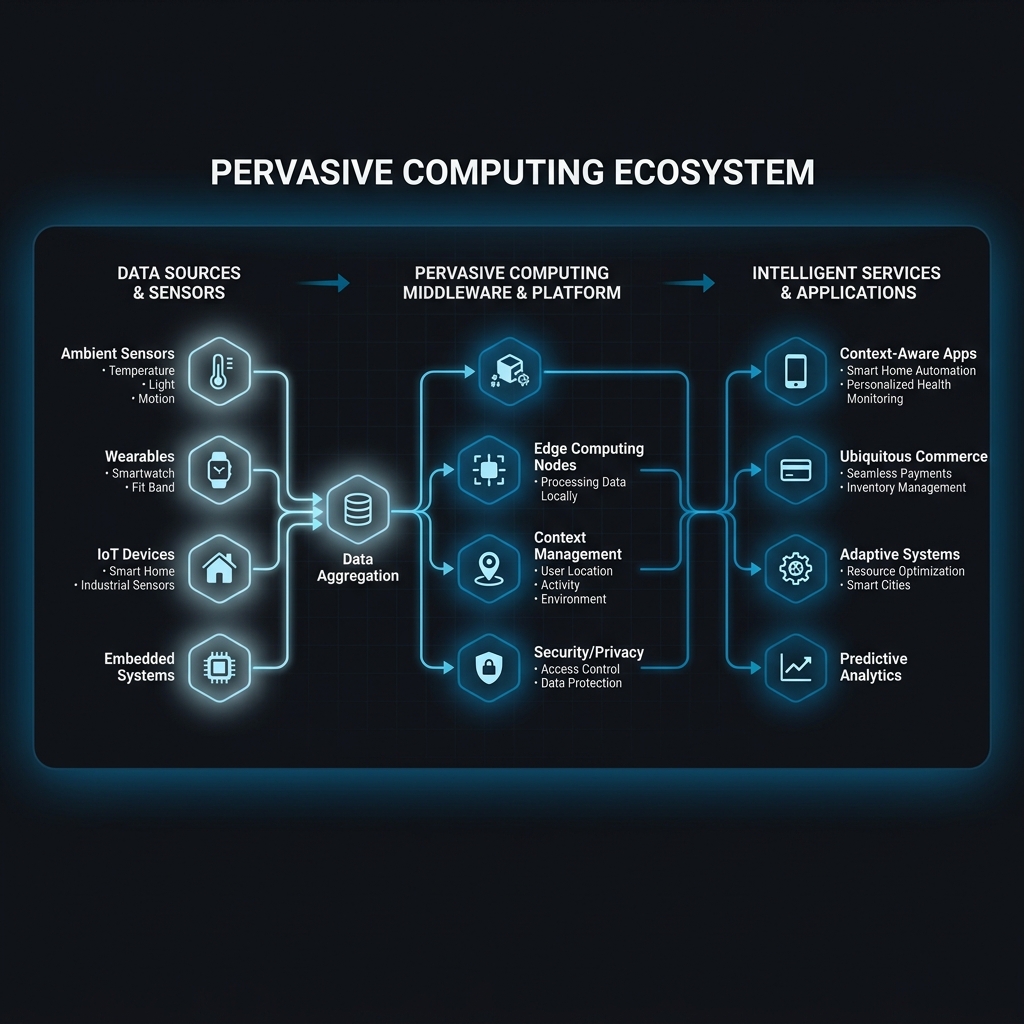
3. The Three Pillars: Ubiquitous Computing, Ambient Intelligence, and Edge Computing
Pervasive technologies is a method for creating truly autonomous environments by combining distributed hardware with localized intelligence. Understanding its impact requires looking at three distinct but overlapping layers. These layers work together to create the "invisible" experience.
Ubiquitous Computing: The Hardware Layer
Ubiquitous computing is the physical presence of technology. It involves embedding sensors, microcontrollers, and wireless chips into the world around us. In 2026, these chips are smaller, cheaper, and more energy-efficient than ever. We see them in smart concrete that monitors structural health and in wearable textiles that track employee fatigue in high-risk environments. The goal here is "omnipresence"—guaranteeing that data can be captured from any point in a business process.
Ambient Intelligence (AmI): The Interaction Layer
Ambient intelligence is how the environment senses and responds to humans. It is the "brain" of the pervasive system. An AmI environment is sensitive to the presence of people, adaptive to their needs, and proactive in its support. It uses computer vision, acoustic sensors, and behavioral modeling to understand context. It doesn't wait for a command; it anticipates intent.
Example: An ambient office knows when a meeting is getting tense based on voice tones. It can subtly adjust the airflow or lighting to reduce stress levels without anyone touching a switch. It just works.
Edge Computing: The Processing Layer
Distributed systems cannot rely purely on the cloud. Sending every heartbeat or vibration sensor reading to a central server in a different country creates too much latency. Edge computing allows data to be processed locally—on the device itself or a nearby gateway.
According to Gartner (2024), 75% of enterprise-generated data will be processed at the edge by 2026. This localized processing is what makes ambient intelligence possible. It allows for millisecond response times. This is essential for safety systems in manufacturing or autonomous logistics. It is also far more efficient to process 1GB of sensor data at the edge and only send a 1KB "status ok" message to the cloud.
4. The Hardware & Connectivity Infrastructure (Closing the Gaps)
Autonomous system design is a method for eliminating manual data collection by using self-powering hardware and next-generation networks. The "invisible" nature of these systems depends on hardware that doesn't need constant maintenance. In 2026, several key advancements have closed the gaps that previously held back widespread adoption.
Sensors & MEMS: The Digital Senses
Micro-electromechanical systems (MEMS) are the "eyes and ears" of these systems. Modern MEMS sensors can detect gas leaks, microscopic vibrations, or subtle changes in humidity while consuming microwatts of power. These sensors are now integrated directly into building materials during construction. We are also seeing the rise of "soft sensors"—AI models that can infer a complex state (like a machine's health) by combining data from several simple, cheap sensors.
Energy Harvesting: Killing the Battery
The biggest barrier to widespread adoption was always the battery. Changing 50,000 batteries in a factory every year is not feasible. Energy harvesting has solved this. Devices now draw power from:
- RF Harvesting
Energy from Wi-Fi or cellular signals.
- Thermal Gradients
Temperature difference between machines and air.
- Kinetic Energy
Vibrations from factory floors or movement.
- Indoor PV
Cells optimized for LED office lights.
This allows for "deploy and forget" sensor networks that last for the entire lifecycle of the asset they monitor. No cables. No maintenance. Pure autonomy.
Next-Gen Connectivity: 6G and Beyond
Connectivity is the glue. While 5G provided the initial bandwidth, 2026 is seeing the early rollout of 6G features, specifically "integrated sensing and communication" (ISAC). This allows the network itself to act as a sensor, detecting the movement of objects and people without needing dedicated hardware. For lower-power needs, protocols like Matter and Zigbee handle the mesh networking required for thousands of small sensors to talk to each other reliably.
Digital Twins: The Real-Time Mirror
Every physical asset in an intelligent environment now has a digital twin. Sensors feed real-time data into a virtual model. This allows managers to run "what-if" simulations or predict failures before they happen in the physical world. If a sensor in a pump detects a specific vibration pattern, the digital twin can instantly calculate the remaining lifespan of that part and order a replacement automatically.
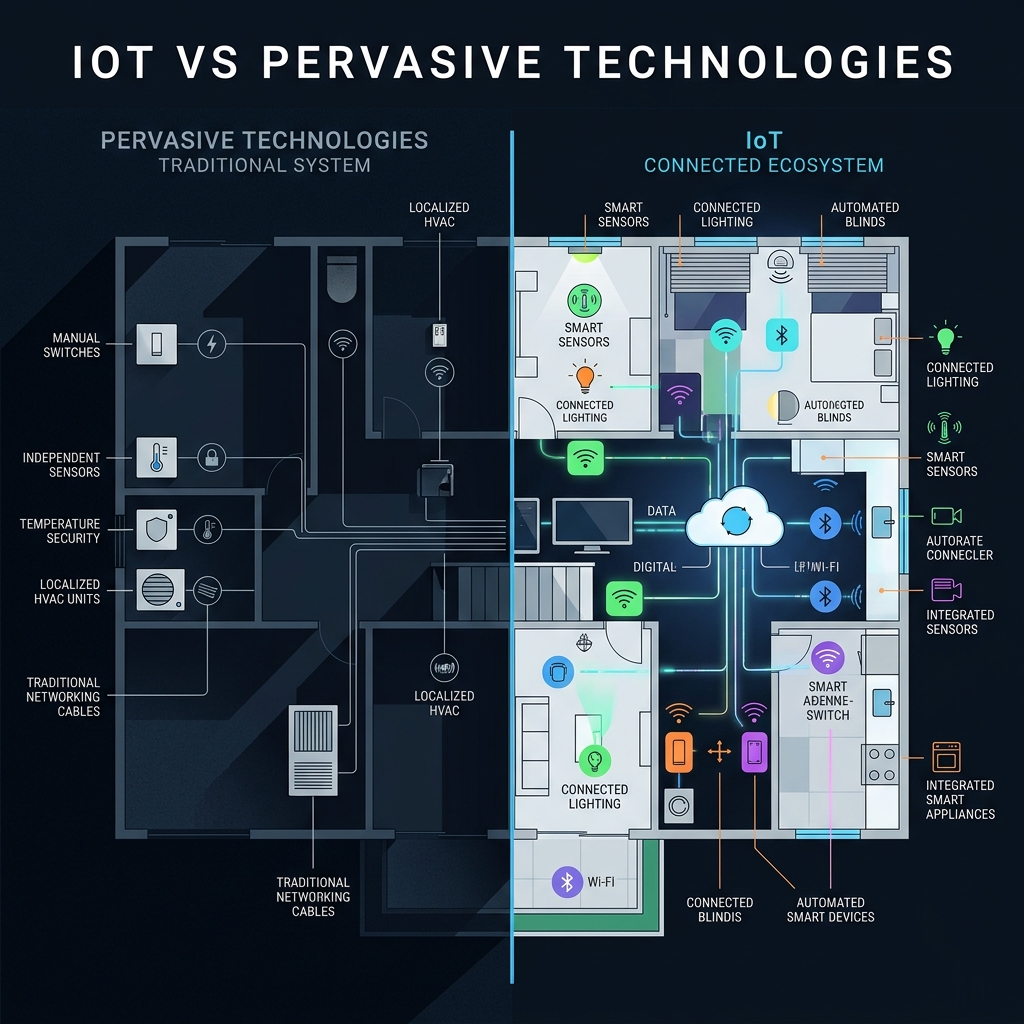
5. Comparison Table: Embedded Systems vs. Traditional IoT vs. Pervasive Intelligence
Ambient computing is a method for shifting from manual monitoring to autonomous optimization. To understand where your business sits on the maturity curve, use this comparison.
| Feature | Traditional IoT | Ambient Systems | Pervasive Intelligence |
|---|---|---|---|
| Primary Goal | Connectivity & Monitoring | Ambient Assistance | Autonomous Optimization |
| Data Processing | Cloud-centric | Edge + Cloud | Distributed / On-device AI |
| Human Interaction | Dashboards & Manual Alerts | Natural / Voice / Gesture | Invisible / Zero-UI |
| Intelligence Level | Rule-based | Context-aware | Agentic / Self-learning |
| Business Example | Smart Thermostat | Smart Office HVAC system | Predictive Energy Grid Management |
6. The Rise of Agentic AI in Pervasive Environments
This invisible approach is a method for transforming raw environmental data into autonomous decisions via agentic AI models. The true power of these systems is unlocked when we add a layer of autonomy. This is where Agentic AI Architectures come in.
Traditional AI acts like a search engine—you ask a question, and it gives an answer. Agentic AI acts like an employee. It has goals, it can use tools, and it can make decisions. In an intelligent environment, these AI agents use the distributed sensor data as their "eyes" and the connected actuators as their "hands."
From Sensing to Acting
Ambient systems require a closed-loop system. Sensing is only half the battle. The other half is "acting." Agentic AI models are designed to inhabit these environments. They don't just report that a room is too hot; they calculate the most energy-efficient way to cool it based on the number of people present, the time of day, and current energy prices. Then they execute that plan.
Our Perspective: AI Employees in the Physical World
We deploy "AI Employees" specifically designed for these ecosystems. These aren't chatbots. They are autonomous agents that manage physical and digital workflows. They monitor embedded computing applications in real-time and take corrective action before a human even realizes there is a deviation from the plan. This is the difference between having a "smart home" and having a "butler."
Key Takeaways
- Agentic AI transforms sensing into autonomous action.
- AI Employees manage the entire physical/digital loop.
- Distributed intelligence provides the 'eyes' and 'hands' for AI agents.
7. Industry-Specific Embedded Intelligence Applications
Distributed computing is a method for solving domain-specific challenges through invisible sensing and proactive automation. These systems are not one-size-fits-all. Every industry has unique "blind spots" that these technologies can illuminate.
Manufacturing & Industry 4.0: The Dark Factory
In manufacturing, distributed intelligence is the backbone of the "dark factory"—facilities that can operate with minimal lighting and human presence. Sensors monitor everything from the acoustic profile of a bearing to the chemical composition of exhaust gases. According to Deloitte (2024), AI-driven predictive maintenance can reduce downtime by up to 50% and extend equipment life by 20%.
Logistics & Supply Chain: Item-Level Intelligence
AI in Logistics is no longer just about route optimization. Ambient tracking allows for "item-level" intelligence. Every pallet can communicate its weight, orientation, and environmental conditions. If a crate of sensitive pharmaceuticals is dropped or exposed to light, the system instantly flags it, prevents it from being shipped, and orders a replacement.
Precision Agriculture: The Intelligent Field
These distributed systems are revolutionizing farming. Underground sensors monitor soil moisture and nutrient levels at the root level. Drones equipped with multispectral cameras fly overhead, communicating with autonomous tractors. If a specific patch of crops shows signs of pest infestation, the system directs a precision sprayer to treat only those plants. This reduces chemical use by up to 90%.
Retail & Customer Experience: Frictionless Commerce
In retail, invisible tech is ending the "check-out" era. Computer vision and weight sensors on shelves track what customers pick up. As they walk out, the system automatically charges their account. Beyond just payments, ambient systems track "gaze time" and customer flow. This helps managers optimize store layouts in real-time based on actual behavior.
Smart Healthcare: The Patient-Centric Environment
The future of healthcare is ambient. We are moving beyond the Apple Watch. Ambient clinical intelligence uses microphones and cameras in patient rooms to automatically document consultations. This allows doctors to focus on the patient instead of a computer screen. Remote patient monitoring now uses wall-mounted radar sensors that can detect a fall or a change in breathing patterns without the patient wearing any device at all. It maintains patient dignity while providing 24/7 safety.
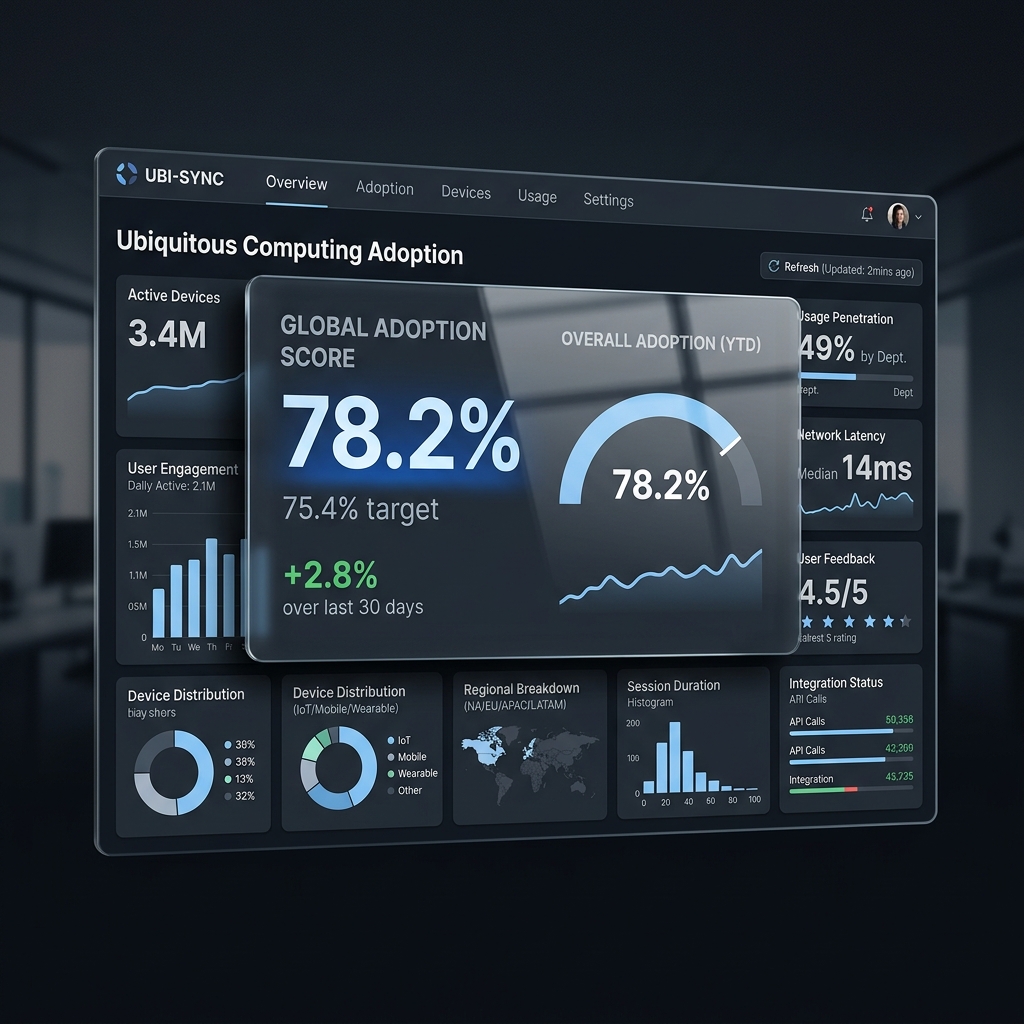
8. The Economic Impact: ROI of the Invisible Revolution
Omnipresent intelligence is a method for driving bottom-line growth by eliminating operational friction and reducing human error. Investing in ubiquitous computing is often seen as a capital-intensive hardware play. However, the long-term economic impact is driven by operational efficiency and risk mitigation.
Reducing "Shadow Work"
Shadow work is the time employees spend performing tasks that aren't part of their job description—like searching for a missing tool in a warehouse. Distributed systems eliminate shadow work. When the environment knows where everything is, humans are freed to focus on high-value decision-making. (Most managers underestimate the cost of shadow work until it's gone.)
Energy Optimization
Buildings are responsible for nearly 40% of global energy consumption. Ambient systems can reduce this by 15-30% by precisely matching energy use to actual occupancy and external weather conditions. In 2026, with rising carbon taxes and energy volatility, this optimization is a direct contributor to the bottom line.
Preventing Catastrophic Failure
The cost of a sensor is negligible compared to the cost of a factory fire or a multi-day network outage. These distributed systems provide the "early warning system" that shifts maintenance from reactive to proactive. According to McKinsey (2024), companies that adopt pervasive intelligence at scale see a 10-15% increase in overall equipment effectiveness (OEE).
9. Implementation Strategy: How Businesses Adopt Invisible Systems
Digital presence is a method for gradual digital transformation that starts with high-impact pilots and scales via standardized architectures. Adopting these systems is a strategic shift, not just a hardware purchase. We follow a structured four-step process to guarantee ROI.
Step 1: Automation Audit
Identify blind spots and high-friction areas where ambient sensing can replace manual data entry or labor.
Step 2: Standards
Avoid proprietary traps. Use standardized stacks like Matter or OPC-UA to ensure long-term interoperability.
Step 3: Zero Trust
Implement hardware-level security and behavioral fingerprinting for every edge device in the ecosystem.
Step 4: Pilot to Scale
Start with a focused 90-day pilot for a high-cost problem before scaling horizontally across the enterprise.
10. The Challenges: Privacy, Ethics, and Data Sovereignty
Ambient data collection is a method for gathering deep environmental insights that must be balanced against privacy and ethical standards. We must address the elephant in the room. If technology is everywhere and sensing everything, what happens to privacy?
The Privacy Paradox
Ambient intelligence requires data to function. To maintain trust, businesses must adopt "Privacy by Design." This means processing sensitive data at the edge. For example, a computer vision sensor in a retail store should never send actual video to the cloud; it should only send a coordinate point representing a person. The goal is "insight without identity."
Data Sovereignty and Ownership
Who owns the data generated by a sensor in a leased warehouse? In 2026, data sovereignty is a major legal hurdle. Contracts must explicitly state that the insights generated by these environments belong to the business operating them, not the vendor who sold the hardware. Businesses must also make certain they aren't becoming overly dependent on a single platform that could lock them in with high fees later.
Avoiding "Technical Bloat"
Just because you can sense something doesn't mean you should. Ambient systems can lead to data drowning. The key is to focus on "actionable intelligence." If a piece of data doesn't lead to an automated action or a better human decision, it is just noise.
11. Conclusion: The Future is Invisible
The ultimate goal of invisible computing is to stop being a "topic." We don't talk about the "pervasive technology" of electricity or indoor plumbing anymore; we just expect them to be there. We are entering an era where your business infrastructure will be just as intelligent and just as expected.
Your office will know when your team is burnt out. Your supply chain will reroute itself around a storm before the weather report is even finished. Your factory will fix its own machines. This transition from manual overhead to distributed intelligence is the defining competitive advantage of the next five years.
The most successful technology is the one you don't notice. It's the one that lets you focus on your business strategy while it handles the millions of microscopic decisions that keep the lights on and the engines turning. At UseShift, we believe that the best way to predict the future is to automate it into the very walls of your business.
Ready to make your operations intelligent?
At UseShift, we don't just talk about the future—we build it. Whether you need to deploy agentic AI at the edge or audit your existing infrastructure for automation opportunities, we are your partner in the invisible revolution.
Book a free AI Automation AuditKey Takeaways
- Pervasive technology is moving from 'connected' to 'cognitive' environments.
- Energy harvesting and edge computing have solved the battery and latency barriers.
- The ROI comes from eliminating 'shadow work' and optimizing energy and maintenance.
- Privacy by Design and Zero Trust are mandatory for distributed sensing networks.