
What is a MEAN Stack Developer?
A MEAN stack developer is a full-stack engineer specializing in MongoDB, Express.js, Angular, and Node.js. In 2026, these professionals act as the architects of autonomous AI agents, using JavaScript across the entire stack to build scalable, real-time enterprise applications.
The tech world moves fast. The demand for a skilled engineer? Even faster. As we move through 2026, the traditional boundaries of full-stack engineering are blurring. We are no longer just building websites or apps. We are building the infrastructure for autonomous agents. These agents require a stable, scalable, and real-time foundation that only specific tech stacks can provide.
A mean developer is a full-stack engineer specializing in MongoDB, Express.js, Angular, and Node.js. In 2026, this role has expanded to include deep integration with AI ecosystems. These professionals are no longer just coding features; they are architecting systems that reason, act, and learn, providing the backbone for modern autonomous agents.
In this guide, we look at why the MEAN stack remains the gold standard for enterprise-grade AI applications. You will learn what to look for when hiring, how the stack has evolved, and why mean stack development is the secret weapon for modern automation. We will go deep into the technical requirements, the market dynamics, and the specific architectural patterns that define a world-class engineering team today.
Key Takeaways
- Unified Language: Using JavaScript/TypeScript across the entire stack reduces context switching and speeds up deployment.
- AI Readiness: The non-blocking nature of Node.js makes it the perfect runtime for orchestrating multiple AI agents.
- Enterprise Power: Angular provides the structure needed for complex, data-heavy dashboards that modern businesses require.
- Flexible Data: MongoDB handles the unstructured data generated by LLMs better than traditional relational databases.
- Scalability: The stack is designed to scale horizontally, which is essential as AI workloads increase in volume.
What is a MEAN Stack Developer?
A mean developer is a full-stack engineer who specializes in four specific technologies: MongoDB, Express.js, Angular, and Node.js. In 2026, this definition has expanded. A senior engineer in this space is now expected to understand how these tools interact with the broader AI ecosystem. They are no longer just "coding a feature." They are designing a system that can reason, act, and learn.
Let's break down the four pillars of the stack and see how they have been re-engineered for the current era.
MongoDB: The Flexible Foundation for AI Data
MongoDB is the "M" in MEAN. It is a NoSQL database that stores data in JSON-like documents. For a full-stack engineer, this flexibility is a massive advantage. When you are building AI-driven workflows, your data structures change constantly. You might start by storing simple chat logs and end up storing complex vector embeddings for a RAG (Retrieval-Augmented Generation) system.
In 2026, MongoDB is not just a document store. It is an AI-native database. According to MongoDB (2025): Their Vector Search capabilities are now used by over 35% of their enterprise clients to power local AI search engines. (We often find that teams try to force-fit AI logs into Postgres, only to hit a performance wall at 100k records.) A modern developer must know how to build these vector indexes and perform similarity searches directly within the database. This eliminates the need for separate vector databases like Pinecone for many mid-sized projects, simplifying the architecture significantly.
Express.js: High-Velocity Routing and API Design
Express is the "E". It is a minimal and flexible Node.js web application framework. It provides a thin layer of fundamental web application features without obscuring the Node.js features you already know. In mean stack development, Express acts as the glue. It handles routing, middleware, and API endpoints.
Its minimalist philosophy is its greatest strength. When building an AI agent, you might make dozens of API calls per second. Inventory checks, credential verification, natural language processing. You cannot afford framework bloat. Express allows for high-speed routing that minimizes the "time to first token" for AI responses. A senior dev will use Express to build high-performance middleware that handles rate limiting, authentication, and logging. This ensures the system stays stable under the heavy load typical of autonomous workflows.
Angular: The Framework for Complex User Journeys
Angular is the "A". Developed by Google, it is a development platform built on TypeScript. While some developers prefer the simplicity of React, Angular remains the choice for large-scale enterprise applications. It is "opinionated," meaning it has a standard way of doing things.
In 2026, Angular has evolved with its "Polaris" edition, focusing on performance and signals. Signals allow for fine-grained reactivity. This is perfect for AI dashboards that need to update specific UI elements—like a status bar or a log—without re-rendering the entire page. It makes the interface feel fast and fluid. For a frontend developer, Angular's built-in dependency injection and modular structure mean that code remains maintainable. Even when the application grows to hundreds of thousands of lines.
Node.js: The Real-Time Execution Engine
Node.js is the "N". It is a cross-platform, open-source JavaScript runtime environment. Node.js runs the V8 JavaScript engine outside of the browser. This allows developers to use JavaScript to write command-line tools and for server-side scripting.
For a backend developer, Node.js is the most powerful part of the stack. Its non-blocking, event-driven architecture is tailor-made for real-time applications. Node.js uses a single-threaded event loop to handle thousands of concurrent connections. This is the opposite of traditional servers like Apache that create a new thread for every connection. In the era of agentic AI, this architecture is a life-saver. One agent might be waiting for an LLM response while simultaneously listening for a user interrupt. Node handles this gracefully. Every time.
Essential MEAN Stack Developer Skills
Finding a qualified candidate requires looking for specific expertise across MongoDB, Express, Angular, and Node.js. If you are looking to hire, you need to look beyond the basic syntax. The bar has been raised. A proficient engineer in 2026 must master both the legacy foundations and the new frontiers of AI orchestration.
Frontend Mastery in Angular
Angular is a complex beast. A junior might know how to make a component, but a senior understands RxJS (Reactive Extensions for JavaScript). RxJS allows you to handle asynchronous data streams with ease. This is essential for building dashboards that update in real-time as an AI agent completes tasks. Imagine an agent browsing the web for a user. The UI needs to show the user exactly which page the agent is on, what it found, and what its next step is. RxJS makes this complex data flow manageable.
You should also look for experience with State Management (NgRx). When your application grows, managing data across dozens of components becomes a nightmare. NgRx provides a single source of truth, making the app predictable and easier to test. Enterprises running data-heavy operations often prioritize this skill to avoid frontend regressions.
Backend Architecture and Security
The backend is where the logic lives. A top-tier engineer knows the difference between REST and GraphQL. While REST is the standard, GraphQL is becoming popular for complex data fetching. GraphQL allows the frontend to request exactly the data it needs, which is essential for mobile apps or low-bandwidth environments.
Security is non-negotiable. Your developer must understand JWT (JSON Web Tokens), OAuth2, and how to prevent prompt injection if the backend interacts with an LLM. They should be comfortable setting up middleware that sanitizes every input. They must also be familiar with "Zero Trust" principles. Every service within the stack must verify the identity of every other service.
Database Engineering for Scale
Anyone can write a find() query. A pro understands aggregation pipelines. They know how to index their collections to ensure queries don't slow down as the database grows to millions of records. They also understand the trade-offs between embedding data and using references. In 2026, they must also understand how to optimize MongoDB for write-heavy workloads, as AI agents generate massive amounts of log data and state history.
NEW for 2026: AI Agent Orchestration
This is the new "plus" in the MEAN stack. The best mean stack developers are now learning tools like LangChain or building custom agentic frameworks. They know how to connect a Node.js server to an OpenAI or Anthropic API, manage the conversation state in MongoDB, and display the agent's progress in an Angular frontend.
According to Gartner (2025): 70% of enterprise software will include some form of autonomous agent capability by the end of 2026. If your developer doesn't understand the basics of AI integration, they are already behind. They need to understand concepts like "Chain of Thought," "Self-Correction," and "Tool Use"—and how to implement these in a Node.js environment.
Architecture Patterns for AI Agents in MEAN
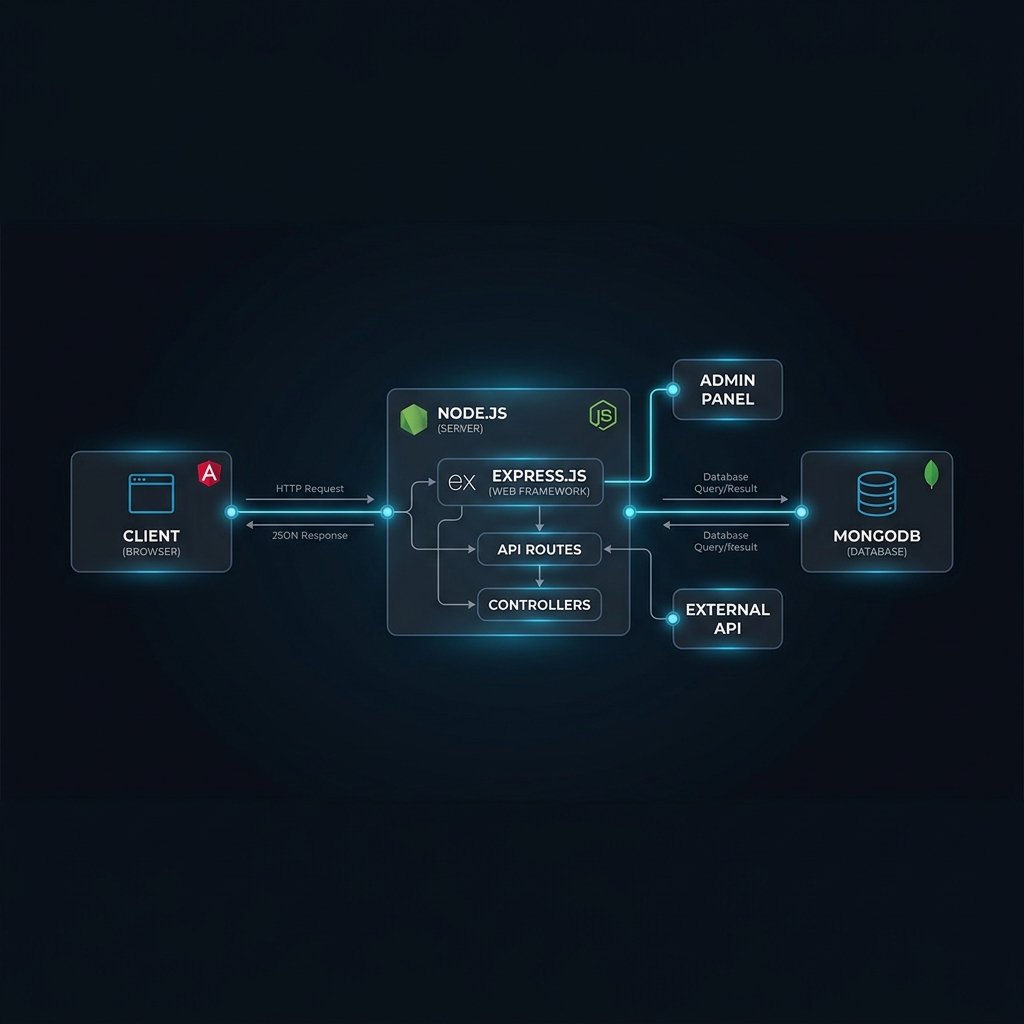
Successful AI implementation in the MEAN stack depends on proven architecture patterns that use the strengths of MongoDB, Express, Angular, and Node.js. To truly understand mean stack development in 2026, you have to look at how these pieces fit together. We typically see three main patterns:
1. The Real-Time Observer Pattern
In this pattern, the Node.js server acts as an orchestrator. When an AI agent starts a task, it emits events via WebSockets. The Angular frontend listens for these events and updates the UI instantly. This provides the user with transparency—they can see exactly what the AI is doing at any moment.
2. The Task Queue Pattern
AI tasks can be slow. An LLM might take 10 seconds to respond. A senior engineer will not make the user wait on a spinning wheel. Instead, they will use a task queue like BullMQ backed by Redis. The Express API receives the request, adds it to the queue, and returns a "Task ID" immediately. A separate Node.js worker process picks up the task, processes the AI logic, and updates the state in MongoDB. Once finished, it notifies the user via the WebSocket connection.
3. The RAG Pattern (Retrieval-Augmented Generation)
This is how businesses use their own data with AI. The developer uses MongoDB Atlas Vector Search to find relevant snippets of company documents. These snippets are then sent to the LLM as "context" along with the user's question. This ensures the AI's answer is grounded in the company's specific facts, reducing hallucinations. B2B SaaS teams are increasingly adopting this pattern to build private, internal knowledge bases.
Comparison Table: MEAN vs. MERN Stack
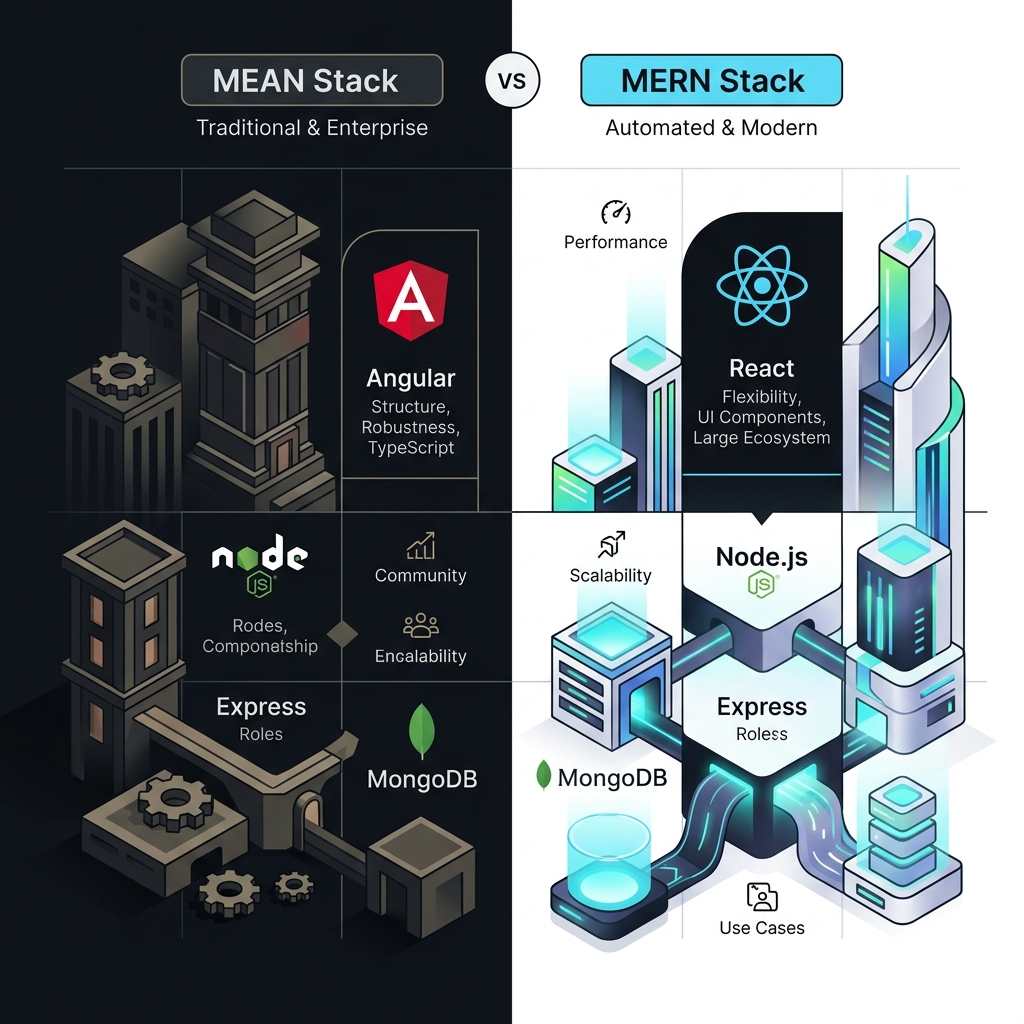
One of the most common questions we get at UseShift is: "Should I use MEAN or MERN?" Both are excellent, but they serve different purposes.
| Feature | MEAN Stack | MERN Stack |
|---|---|---|
| Frontend Framework | Angular (Opinionated, Full Framework) | React (Flexible, Library) |
| Language | TypeScript (Native / Mandatory) | JavaScript / JSX (Optional TS) |
| Learning Curve | Steeper (requires learning the "Angular way") | Lower (faster to get a basic UI running) |
| Development Speed | Slower initial setup, faster scaling | Faster initial setup, can get messy |
| Data Binding | Two-way (automatic sync between UI and Model) | One-way (more explicit control) |
| Architecture | MVC (Model-View-Controller) | Component-based (flexible) |
| Tooling | CLI-driven, batteries included | Ecosystem-driven, select your own tools |
| Enterprise Support | Built-in (Modules, DI, Testing) | Requires third-party libs (Redux, Router) |
| Best For | Enterprise, large-scale apps, complex dashboards | Startups, MVPs, UI-heavy apps |
If you are building a massive internal tool for a global corporation, hire a mean developer. If you are building a trendy social media app, MERN might be the way to go. We've compared similar architectural choices in our AWS ECS vs Kubernetes guide.
The 2026 Evolution: MEAN Stack & Autonomous Agents
The integration of the MEAN stack with autonomous agents represents a major shift in software capabilities, enabling systems that go beyond static logic. The reason we love the MEAN stack at UseShift is its synergy with AI. We don't just build software. We build custom AI workflows. The MEAN stack provides the perfect "Digital Nervous System" for these workflows.
Real-Time Event Loops and AI Concurrency
Node.js is built on an event loop. This is exactly what an AI agent needs. An agent is constantly "thinking," "acting," and "observing." Node.js can handle these loops without blocking other users or processes. This ensures your AI doesn't freeze your entire app while it is processing a complex request. A developer who understands async/await and how to avoid blocking the event loop is worth their weight in gold.
Angular's Dependency Injection for Multi-Model Support
Angular's dependency injection (DI) system is a hidden gem for AI. It allows you to swap out "brains" or tools for your agent easily. Need to switch from GPT-4 to a local Llama model for a specific task? With a well-architected Angular app, you can inject a different service without rewriting the UI logic. This "pluggability" is essential as new AI models are released every week.
Case Study: Autonomous Procurement Agent
Recently, UseShift built a procurement agent for a mid-sized manufacturing firm. We used the MEAN stack for the entire build.
- MongoDB stored thousands of vendor contracts and historical pricing data.
- Node.js acted as the agent's brain, using a ReAct loop to analyze emails and negotiate prices.
- Express provided the API for the company's existing ERP system.
- Angular gave the procurement team a sleek dashboard to oversee the agent's decisions.
The result? A 22% reduction in raw material costs within three months. This is the power of a dedicated mean stack development team. They didn't just build a portal; they built an "AI Employee."
Security Deep Dive for the MEAN Stack
Securing a MEAN stack application in 2026 requires a multi-layered approach to protect both data and AI models. A senior dev must also be a security specialist. The "AI Wild West" is over. We are now in a world of strict data privacy and sophisticated attacks.
OWASP Best Practices
The stack is vulnerable to classic attacks like NoSQL injection (in MongoDB) and Cross-Site Scripting (XSS) in Angular. A senior dev will use libraries like mongo-sanitize to clean inputs and utilize Angular's built-in XSS protection. They will also implement Content Security Policies (CSP) to restrict where scripts can be loaded from.
AI-Specific Security
When building with LLMs, "Prompt Injection" is the new SQL injection. An attacker might try to trick your agent into revealing sensitive data or ignoring its safety guardrails. A skilled developer will implement "Dual-Model Verification." A second, smaller AI model checks the inputs and outputs of the main model for malicious intent.
Data Sovereignty and Encryption
For our clients in healthcare or finance, data can never leave a specific region. A pro must know how to configure MongoDB's "Global Clusters" to keep data in a specific country. They must also implement encryption at rest and in transit. Even if a server is compromised, the data remains unreadable.
Testing Strategy for Full-Stack MEAN Apps
A detailed testing strategy ensures that every layer of the MEAN stack functions as intended and remains stable during updates. You cannot build a high-performance system without testing. Period. A mean stack dev who doesn't write tests is a liability.
No tests. No stability. No future.
In 2026, we follow a strict "Testing Pyramid" for the MEAN stack.
Unit Testing with Vitest
We test individual functions and components. For Node.js and Angular logic, Vitest has become the standard due to its incredible speed. It allows developers to run thousands of tests in seconds, providing instant feedback.
Integration Testing
This is where we test the interaction between components. Does the Express API correctly save a user's prompt to MongoDB? Does the Angular service correctly parse the JSON response from the backend? We use tools like Supertest for the backend and Angular's built-in testing utilities for the frontend.
End-to-End (E2E) Testing with Playwright
This is the ultimate test. Playwright automates a real browser to simulate a user's journey. It logs in, clicks buttons, and verifies that the AI agent actually performs the task. E2E tests are slower, but they ensure that the system works as a whole. According to DORA (2025): High-performing engineering teams that use E2E automation have a 47% lower change failure rate.
Hiring MEAN Stack Developers: A Strategic Guide
A strategic approach to hiring mean stack developers involves looking beyond technical skills to find true problem solvers who understand the AI field. Finding a good mean stack dev is hard. Finding a great one is nearly impossible if you don't know what to ask. You can't just look at a resume and see "JavaScript" and assume they are ready for 2026.
Where to Look
Avoid the big job boards if you want top talent. Look at GitHub. Look at the contributors to popular Angular or Node.js libraries. Check out specialized platforms like Toptal or niche Slack communities. Or, better yet, partner with an AI development company that already has a vetted team.
The Interview Roadmap
When you get a candidate in the room, don't ask them to reverse a binary tree. Ask them about the stack and how they solve real problems.
Technical Questions to Ask:
- "Explain the Node.js Event Loop as if I'm a five-year-old." If they can't explain it simply, they don't understand it deeply. They should mention things like "waiting for the doorbell" instead of "sitting by the phone."
- "How does Angular handle Change Detection?" You want to hear about Zone.js and the difference between default and OnPush strategies. This shows they understand performance.
- "When would you use a MongoDB Aggregation over a simple query?" Look for an understanding of performance and data shaping. Ask them to explain a
$lookupor a$facetstage. - "How would you integrate an AI agent into a Node.js backend?" This tests their knowledge of the 2026 market. Do they mention streaming responses? Do they mention task queues?
Portfolio Analysis: What to Look For
Don't just look at screenshots. Ask for a link to a GitHub repository.
- Commit History: Do they commit frequently with clear messages?
- Documentation: Is there a README that explains how to run the app?
- TypeScript Usage: Do they use
anyeverywhere, or do they define strict interfaces? - Folder Structure: Is it organized into logical modules?
Red Flags to Avoid
- Lack of TypeScript Proficiency: In 2026, writing plain JavaScript for a large-scale MEAN app is a recipe for disaster.
- Ignoring Tests: If they don't mention testing, their code will break in production.
- No understanding of CI/CD: A modern engineer should know how to deploy their code. If they can't explain a basic GitHub Actions pipeline, pass.
- "Framework Fanaticism": Avoid developers who hate every framework except the one they use. You want a problem-solver, not a fanboy.
MEAN Stack Developer Salary & Market Trends (2026)
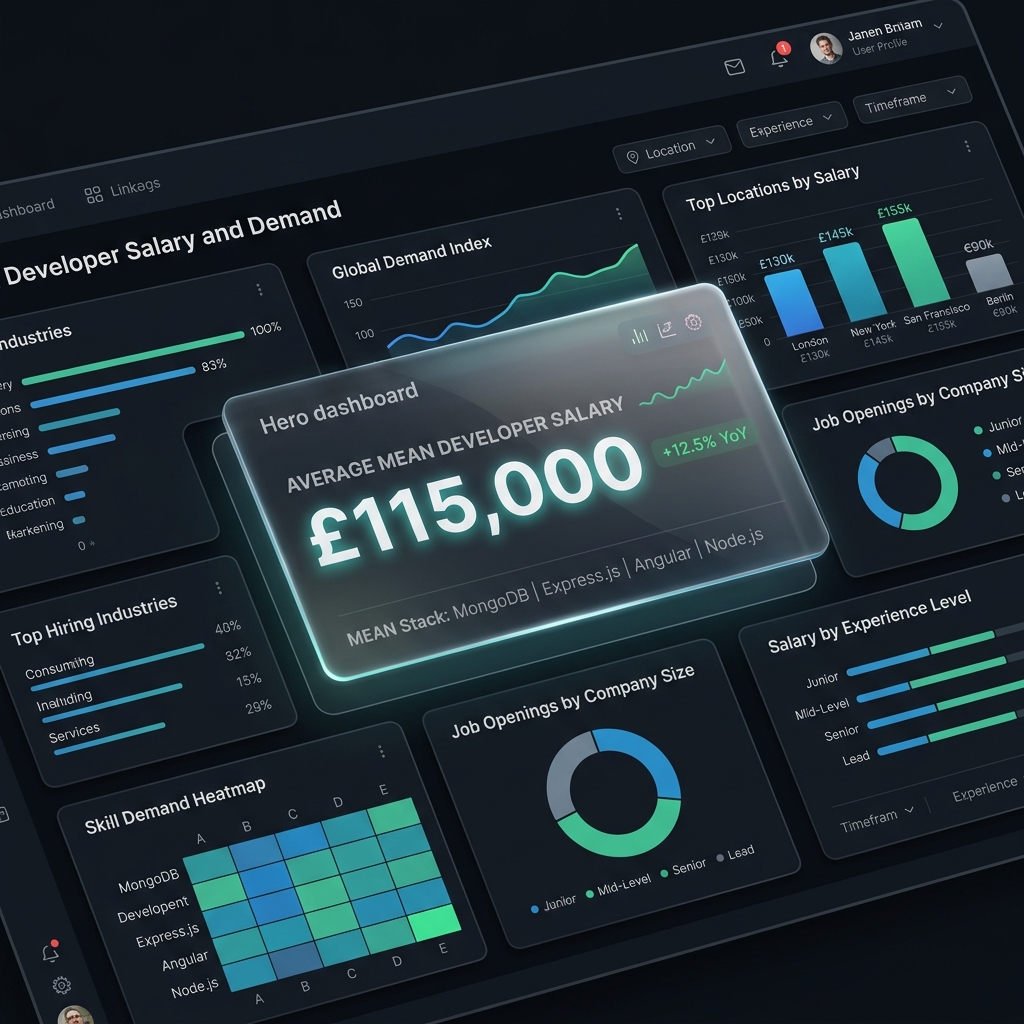
Understanding the market trends and salary expectations for mean stack developers is key to building a competitive engineering team in a tight market. The market for mean stack developers is booming. As companies realize that "off-the-shelf" AI tools aren't enough, they are turning to custom builds. This has driven salaries to record highs.
According to Glassdoor (2026): The average base salary for a Senior MEAN Stack Developer in the USA is $165,000. In tech hubs like San Francisco or New York, this often exceeds $200,000.
Global Salary Estimates (Annual):
- USA: $130,000 - $210,000
- UK: £75,000 - £120,000
- Europe (Germany/Netherlands): €80,000 - €130,000
- Remote (Nearshore/LATAM): $60,000 - $110,000
The "AI premium" is real. A senior dev who can also build agentic workflows can command a 20-30% higher salary than a traditional full-stack dev. They are building revenue-generating assets for the business. They are "Full-Stack AI Engineers."
Final Takeaway
Hiring a mean developer in 2026 is about finding an architect who can navigate the complex world of data, real-time communication, and autonomous agents. The MEAN stack provides the structure, speed, and flexibility required to build the future of business. Focus on the skills that matter: TypeScript, enterprise architecture, and AI orchestration. The businesses that master this stack will be the ones that win the AI race.
Ready to build autonomous infrastructure?
Let's turn your manual overhead into AI-driven efficiency. Our vetted MEAN stack experts are ready to deploy your next-gen AI employees.
Book a free audit with UseShift today