


What is the difference between Agentic AI and Generative AI?
Generative AI creates content (text, images, code) based on human prompts, while Agentic AI acts autonomously to achieve a goal by making decisions, planning multi-step actions, and using external tools without requiring constant human intervention.
Stop prompting. Start delegating.
For the last three years, generative AI has reshaped how we create. But the fundamental shift defining 2026 isn't about creating faster—it's about systems that can do the work for you. Understanding the crucial difference between agentic AI vs generative AI in 2026 is no longer an academic exercise; it's the defining line between businesses that scale linearly and those that scale autonomously.
- The core architectural differences between the two technologies
- Real-world examples of both systems in action today
- How agentic AI uses generative models as its "cognitive engine"
- A simple framework to decide which one your specific workflow needs
- The hidden risks and current limitations you must navigate
What Is Generative AI?
Generative AI is a technology that produces new text, imagery, audio, or code by statistically predicting the most likely output based on a user's prompt.
At its core, it works by analyzing vast amounts of training data and identifying patterns. When you give it a prompt, the model uses those learned patterns to generate a relevant response. It is highly reactive—it sits idle until you tell it what to do, acting essentially as an incredibly advanced autocomplete.
Core characteristics:
- Reactive: Action requires a direct human prompt.
- Content-focused: The end goal is to produce an output artifact (an essay, an image).
- Memoryless: Each session is independent unless context is explicitly fed back in.
Real examples: ChatGPT, OpenAI's GPT-4 architecture, Midjourney image generators, and coding assistants like GitHub Copilot.
Use cases: Writing SEO content with AI-powered content marketing, drafting customer support emails, designing product mockups, and summarizing long documents.
Key Takeaways
- Generative AI is brilliant at creation but terrible at execution.
- It requires a human "in the loop" for every single step.
- It is best deployed for content generation and ideation.
What Is Agentic AI?
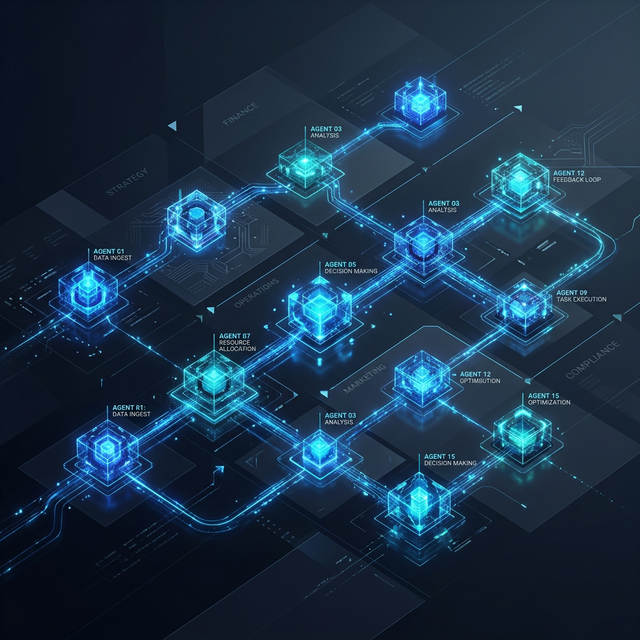
Agentic AI refers to autonomous systems capable of understanding a high-level goal, forming a multi-step plan, interacting with external tools, and executing actions to achieve that goal without continuous human oversight.
Unlike generative models that just predict the next word, agentic systems employ a loop of reasoning: they think about the goal, act by using a tool (like searching the web or querying a database), observe the result, and adapt their plan if necessary.
Core characteristics:
- Autonomous: It initiates actions and pursues goals independently.
- Goal-oriented: It focuses on achieving an outcome, not just generating text.
- Tool-enabled: It can browse, run code, update CRM systems, or send emails.
- Multi-step reasoning: It can break down a complex task and course-correct.
Real examples: OpenAI Operator, Google Project Mariner, autonomous routing in warehouse robots, and advanced workflow orchestration systems.
Use cases: End-to-end workflow automation integrations, proactive healthcare patient monitoring, financial risk management, and smart logistics routing.
Key Takeaways
- Agentic AI executes tasks from start to finish.
- It requires a human "on the loop" (for oversight), not "in the loop".
- It is best deployed for complex operations and decision-making.
Agentic AI vs Generative AI: 5 Key Differences
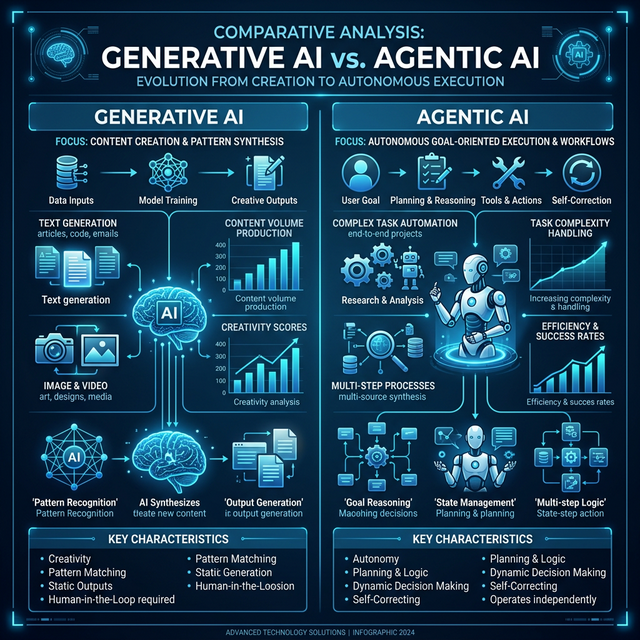
To fully grasp the "agentic AI vs generative AI 2026" landscape, we must look at how they diverge across five critical vectors of operation.
| Factor | Generative AI | Agentic AI |
|---|---|---|
| Primary Focus | Content creation | Decision-making & action |
| Autonomy | Low (requires continuous prompts) | High (self-directed execution) |
| Core Function | Single-step, isolated output | Multi-step task orchestration |
| Workflow Role | Supports steps within a human workflow | Full end-to-end process automation |
| Decision-Making | Basic (statistical pattern matching) | Complex (reasoning + tool use + reflection) |
Primary Focus: Generative systems are built to brainstorm and draft. Agentic systems are built to decide and do. One writes the recipe; the other cooks the meal.
Autonomy: If you stop typing, a generative AI stops working. An agentic AI, once given a directive like "research these 50 prospects and update Salesforce," will run in the background until the job is complete.
Core Function: Generative models handle single-turn queries ("Write a Python script"). Agents handle multi-step tasks ("Write the script, test it, read the error logs, fix the bug, and deploy it").
Workflow Role: Generative AI makes the human worker faster at specific bottlenecks. Agentic AI can often replace the bottleneck entirely by automating the end-to-end flow.
Decision-Making: Generative models hallucinate because they are guessing what sounds right. According to IBM's latest AI research, agentic systems reduce hallucinations by using deterministic tools—like a calculator or a SQL database—to verify their own logic before proceeding.
How Agentic AI and Generative AI Work Together
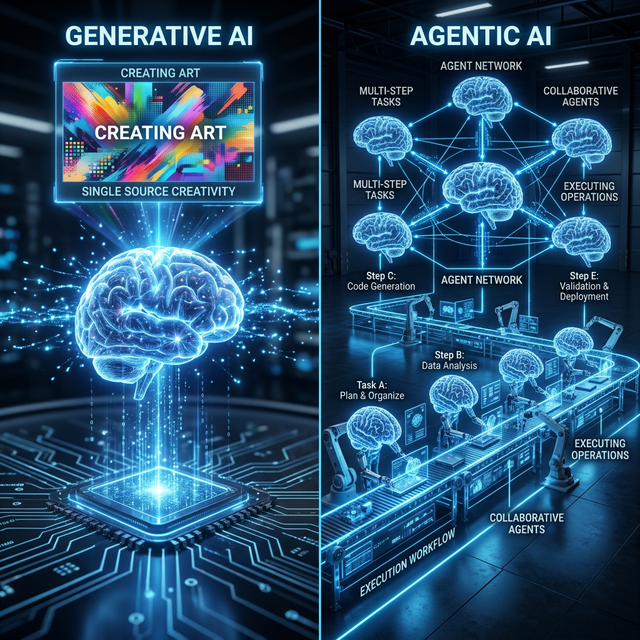
It is a mistake to view this as a battle where one replaces the other. In reality, agentic AI uses generative AI as its cognitive engine.
Imagine you run a fintech startup. You want to automate your quarterly competitor analysis. The Agentic framework provides the scaffolding: it navigates to competitor websites, scrapes the pricing pages, and stores the structured data analytics. But when it needs to synthesize that scraped data into a readable summary for your executive team, it calls upon an underlying Generative Large Language Model (LLM) to write the report.
The agent is the manager; the generative model is the specialized writer. By 2026, the most powerful enterprise systems seamlessly blend the planning capabilities of agents with the creative capabilities of generators.
Real-World Use Cases by Industry
This integration of technologies is driving massive ROI across major sectors.
Healthcare
Generative models are drafting post-visit patient summaries. Meanwhile, agentic systems monitor real-time patient vitals from wearables, autonomously flagging anomalies and scheduling emergency follow-ups without nursing intervention.
Finance & Fintech
In finance, generative AI helps write regulatory compliance reports. Agentic AI is actively monitoring transaction streams, freezing suspected fraudulent accounts in milliseconds, and compiling the necessary audit trails automatically. For scale, AWS enterprise data shows autonomous agents reducing fraud resolution times by 40%.
E-commerce & Logistics
Generative AI writes product descriptions at scale. Agentic AI monitors global supply chain disruptions, automatically rerouting shipments and emailing affected customers when a delay is detected in a specific shipping corridor.
Marketing & Content
While generative AI writes the social media posts, an agentic marketing system analyzes performance metrics, A/B tests headlines, re-allocates ad spend to the best performing channels, and reports back on the ROI automatically.
Cybersecurity
Generative AI helps engineers understand obfuscated malware code. Agentic systems, as noted by Red Hat automation experts, isolate compromised servers, patch vulnerabilities, and deploy network-wide updates before a human analyst even wakes up.
Which One Does Your Business Need?
Choosing between investing in generative scaling or agentic infrastructure comes down to a simple decision framework based on your operational bottlenecks.
- If you need content at scale → Generative AI. Use it to write blogs, draft code, create initial designs, and brainstorm marketing campaigns.
- If you need automated workflows → Agentic AI. Use it when a task requires checking three different systems, making a logical decision, and executing an action in a fourth system.
- If you need both → Agentic AI powered by Generative AI. This is the ultimate 2026 enterprise architecture: systems that can autonomously orchestrate creative generation at scale.
Limitations and Risks
Neither technology is without peril, and their risks are fundamentally different.
Generative AI risks: The primary dangers are informational. Deepfakes, AI hallucinations, copyright infringement, and the rapid spread of misinformation are constant threats. Furthermore, its reactive-only nature means it cannot fix its own mistakes unless prompted to do so by a human.
Agentic AI risks: The dangers here are operational and security-based. Because agents can take actions, a poorly programmed agent could accidentally delete a database, leak customer data via email, or spend an entire company budget on an infinite API loop. Current systems remain in an experimental stage, requiring robust guardrails, strict security permission scopes, and "human-on-the-loop" approval mechanisms for high-stakes decisions.
Conclusion
The conversation has officially moved past text generation. In 2026, understanding the difference between agentic AI vs generative AI is the key to unlocking true operational leverage. As you evaluate your tech stack, remember the paradigm shift: we are moving from AI that helps us work, to AI that does the work.
Key Takeaways
- Generative AI creates; Agentic AI executes.
- Agentic systems use generative models to reason, but rely on external tools to act.
- The ROI of AI in 2026 comes from delegating multi-step workflows, not just generating faster text.
Ready to build autonomous workflows? Discuss your AI roadmap with our team today.