

Which is better in 2026: Flutter or React Native?
The choice between flutter vs react native in 2026 depends on your strategic goals. Choose Flutter for high-performance graphics, pixel-perfect UI consistency, and a unified codebase for mobile, web, and desktop. Choose React Native to leverage the massive JavaScript/React ecosystem, access a larger talent pool, and achieve a native 'look and feel' through the host OS components.
The mobile development landscape of 2026 is defined by unprecedented maturity and the integration of autonomous AI systems.
In this high-stakes environment, the choice between flutter vs react native is no longer just about framework preference; it is a fundamental architectural decision. For senior engineers and CTOs, understanding the ground truth of rendering engines, data pipelines, and ecosystem depth is critical for building scalable, high-performance mobile infrastructure.
Introduction
As we navigate through 2026, we see a mobile world dominated by "Agentic AI" integration, where apps are not just interfaces but active participants in a user's digital ecosystem. In this environment, the performance of your rendering engine and the efficiency of your data pipelines are more critical than ever. Flutter, with its bespoke rendering architecture, and React Native, with its deeply optimized JavaScript-to-native communication layer, remain the two titans of this space.
This comparison is written for senior engineers, technical leads, and CTOs who need to look beyond the marketing fluff and understand the ground truth of mobile development in 2026. We will dive deep into the internals of both frameworks, analyze their performance characteristics in the context of modern hardware, and provide a clear, technical decision framework.
What is Flutter? (Technical Deep-Dive)
Flutter stands as a testament to the power of a "Full-Control" rendering architecture. Unlike other frameworks that rely on the host operating system's UI components, Flutter draws every pixel itself, providing a level of UI consistency that is still unmatched in the industry.
Impeller Engine
Default in 2026, Impeller eliminates shader compilation jank by utilizing Metal and Vulkan for buttery-smooth 120Hz performance.
Dart Macros
Eliminate boilerplate with compile-time code generation for JSON, DI, and state management without external build runners.
What is React Native? (Technical Deep-Dive)
React Native has undergone a profound transformation. The "New Architecture" is now the rock-solid foundation of every project, bringing the performance of native development to the familiarity of the React ecosystem.
JSI & Fabric
The JavaScript Interface (JSI) enables synchronous communication with native C++ objects, eliminating the legacy 'bridge' bottleneck.
Static Hermes
AOT compilation of JavaScript into optimized bytecode provides startup times indistinguishable from native applications.
Key Differences in 2026
| Feature | Flutter (2026) | React Native (2026) |
|---|---|---|
| Language | Dart (with AI-driven macros) | JavaScript/TypeScript (Static Hermes) |
| Rendering | Impeller (Direct-to-GPU) | Fabric (Native Components via JSI) |
| UI Consistency | 100% (Pixel-perfect) | Native Look & Feel (OS-dependent) |
| Hot Reload | Stateful Hot Reload (instant) | Fast Refresh (reliable) |
| Web/Desktop | Native Wasm/Desktop APIs | React Native Web (Good) |
| AI Ecosystem | Deep Gemini Integration | Vast JS-based AI Libraries |
Pros and Cons
Flutter Pros
- Pixel-perfect UI across all platforms
- Exceptional performance with Impeller
- Outstanding documentation and cohesion
- Single codebase for Mobile, Web, Desktop
Flutter Cons
- Dart learning curve for JS teams
- Larger initial binary sizes
- Smaller (but growing) talent pool
React Native Pros
- Massive talent pool and community
- Native Look and Feel by default
- Leverages entire npm/JS ecosystem
- Excellent for sharing logic with Web
React Native Cons
- UI inconsistencies between OS versions
- Complex dependency management
- Occasional 'abstraction leaks' to native
Cross-Platform Architecture
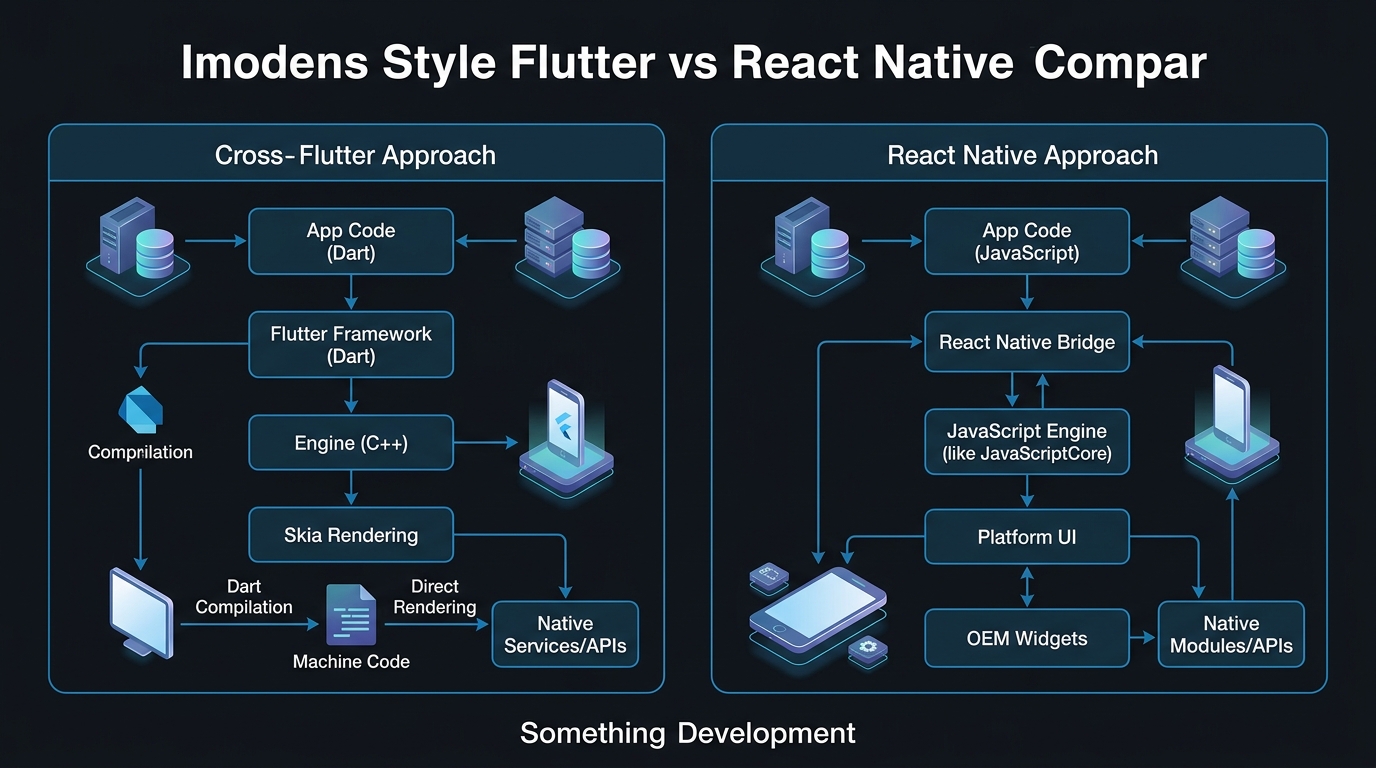
Modern application architecture in 2026 focuses on modularity and AI readiness. Whether using Flutter's layered approach or React Native's JSI-driven architecture, the goal is to build a core engine that can be extended with autonomous capabilities. UseShift recommends a strict TypeScript or sound-Dart approach to ensure long-term maintainability.
FAQ: Flutter vs React Native
Which is better in 2026: Flutter or React Native?
It depends on your goals. Flutter is superior for custom UI consistency and high-performance graphics, while React Native is better for leveraging the massive JS ecosystem and finding a larger pool of developers.
Is Flutter faster than React Native?
In 2026, the gap has narrowed significantly. Flutter's Impeller engine provides buttery-smooth 120Hz UI, while React Native's JSI and Static Hermes offer native-level performance for most business logic.
Can I share code between mobile and web?
Yes, both frameworks support this. Flutter for Web is highly mature and uses WebAssembly for performance, while React Native Web allows you to share significant logic with standard React web apps.
Which is easier to learn?
React Native is easier if you already know JavaScript/React. Flutter uses Dart, which is easy to learn but requires mastering a new language and its "everything is a widget" philosophy.
Does Google still support Flutter?
Yes, Google continues to invest heavily in Flutter, particularly in AI integration with Gemini and the new Impeller rendering engine.
Conclusion
The choice between flutter vs react native in 2026 is no longer about technical limitations, but about strategic alignment. Both frameworks are world-class, but they serve different engineering philosophies.
At UseShift, we partner with B2B teams to design and implement high-performance mobile infrastructure. Our expert engineers understand the nuances of both frameworks and can help you choose the right path for your next project. Ready to build something extraordinary? Contact UseShift today for a technical strategy session.
Key Takeaways
- Flutter offers unmatched UI consistency and 120Hz rendering.
- React Native provides the largest talent pool and deepest ecosystem.
- Both frameworks have evolved to eliminate legacy performance bottlenecks.
- The future of mobile lies in on-device AI and unified multi-platform codebases.