

What is the best DevOps certification in 2026?
The 'best' certification depends on your stack, but the AWS Certified DevOps Engineer – Professional and the Certified Kubernetes Administrator (CKA) are the most globally recognized and command the highest salaries in 2026.
Lead the automation revolution.
In the rapidly evolving landscape of 2026, DevOps certification has transitioned from being a "nice-to-have" credential to a fundamental requirement for engineers looking to lead high-performing technical teams. As organizations continue to move toward agentic AI-driven workflows and hyper-automated infrastructure, the role of a DevOps engineer has become more complex and critical than ever before.
Why Get a DevOps Certification?
A devops certification is not just about the digital badge on your LinkedIn profile; it represents a commitment to industry standards and best practices in an era where infrastructure is increasingly autonomous.
Key Takeaways
- Validates expertise in bridging the gap between development and operations.
- Provides a structured learning path for mastering complex CI/CD and AI-driven automation.
- Significantly increases marketability and earning potential in a competitive tech landscape.
Top DevOps Certifications for 2026
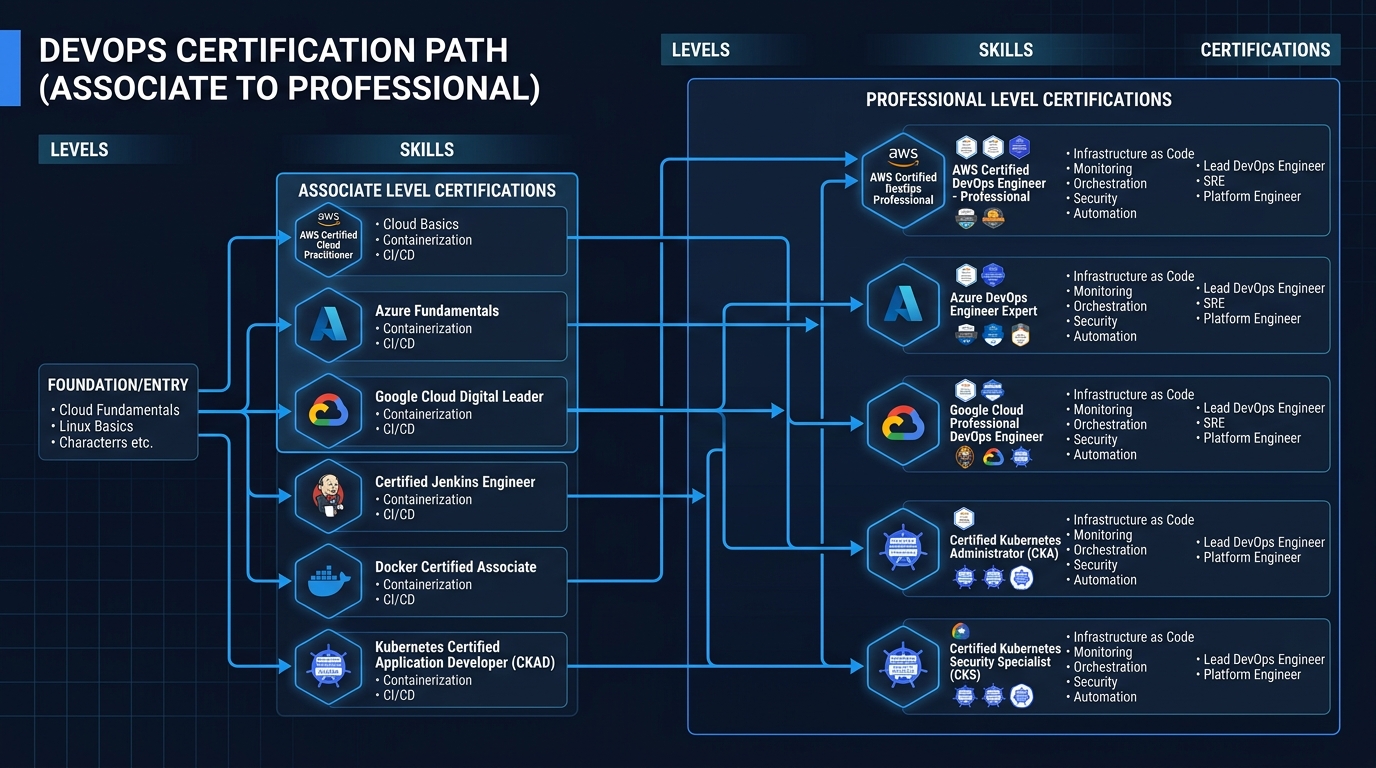
The 2026 DevOps landscape is dominated by cloud-native platforms and container orchestration. Here are the leading paths for professional growth:
1. AWS DevOps Professional
The gold standard for AWS-heavy organizations. Focuses on automation, governance, and self-healing systems.
2. Azure DevOps Expert
Essential for Microsoft ecosystem mastery, focusing on Azure DevOps services and GitHub Enterprise integration. See our full Azure cert path for the full 2026 roadmap.
3. Google Cloud DevOps Engineer
Perfect for those focusing on Site Reliability Engineering (SRE) principles and performance monitoring.
4. Certified Kubernetes Administrator
The most practical, hands-on certification for managing containerized workloads at scale.
Deeper Dive: Essential Tools & Skills for 2026
In 2026, the modern DevOps engineer is expected to be a polyglot of infrastructure tools. While the cloud platform provides the "where," these tools provide the "how":
Infrastructure as Code (IaC)
Terraform remains the industry standard, but Pulumi has carved out a significant niche for developers who prefer TypeScript or Python over HCL. Mastering at least one of these is non-negotiable for anyone seeking a devops certification in 2026.
Read our full guide to IaC Tools →CI/CD Pipelines
The battle between GitHub Actions and GitLab CI has pushed both platforms to integrate advanced AI features. For enterprise environments, Jenkins still holds strong for complex, on-premise requirements.
Comparison: Top DevOps Certifications
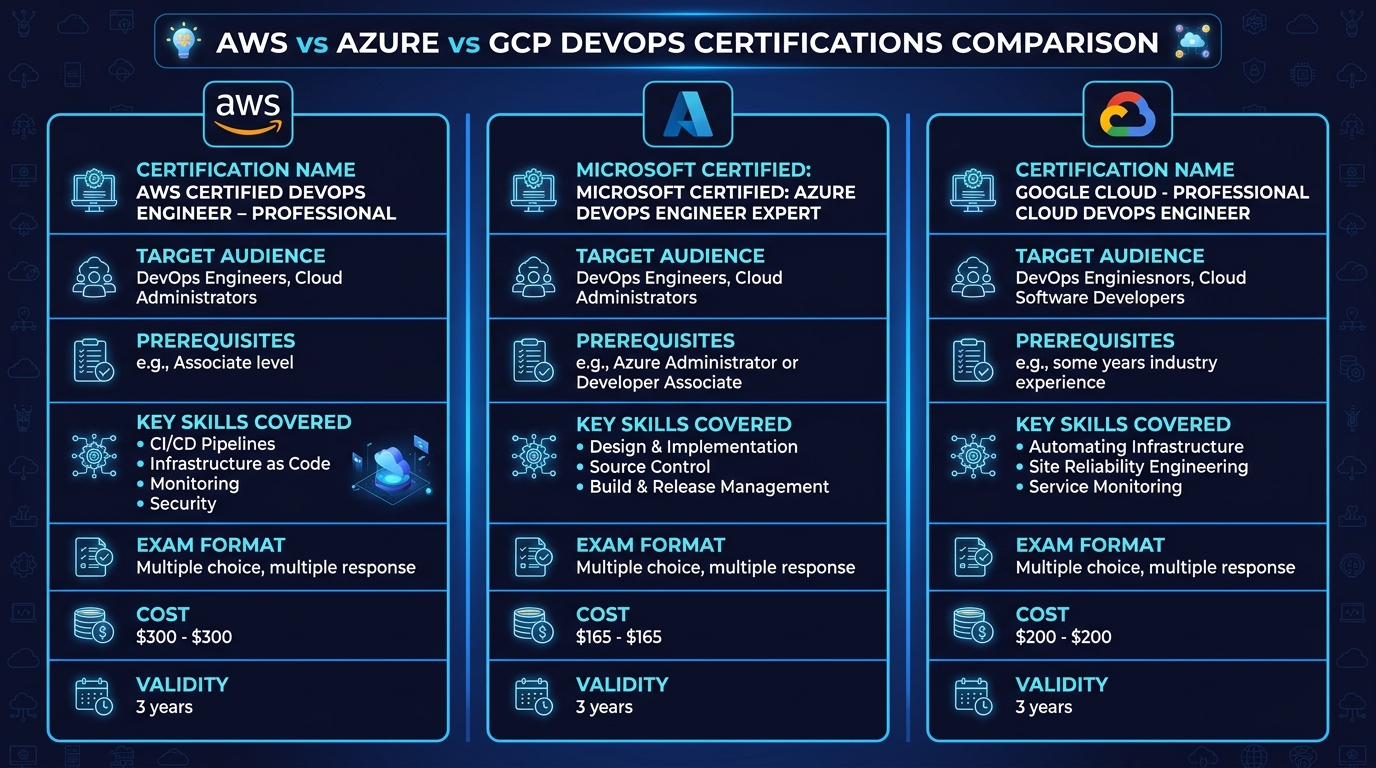
Choosing the right **devops certifications** depends on your technical background and career goals. Use this comparison to guide your decision:
| Certification | Provider | Focus Area | Difficulty |
|---|---|---|---|
| AWS DevOps Professional | Amazon | Automation & Cloud Ops | High |
| Azure DevOps Expert | Microsoft | CI/CD & MS Stack | Medium-High |
| GCP DevOps Engineer | SRE & Performance | High | |
| CKA (Kubernetes) | CNCF | Container Management | Very High |
| Terraform Associate | HashiCorp | Infrastructure as Code | Medium |
The Evolution: From DevOps to Platform Engineering
If you have been following the industry discourse leading into 2026, you will have noticed a significant shift in terminology. The traditional "DevOps Engineer" role is increasingly being rebranded and restructured into "Platform Engineering." This isn't just a change in title; it's a fundamental shift in how automation is delivered. Standard DevOps often focused on building bespoke pipelines for individual product teams, which struggled to scale across massive enterprises. Platform Engineering, conversely, focuses on building an Internal Developer Platform (IDP)—a self-service product that developers consume to deploy their code without ever needing to write a line of Terraform or configure a Kubernetes manifest.
Because of this shift, the most valuable devops certifications in 2026 heavily emphasize creating scalable, reusable infrastructure blueprints. The exams have evolved from asking "How do you deploy this app?" to "How do you securely provision a multi-tenant self-service deployment portal for 50 concurrent engineering teams?" Understanding this macro-trend is critical; when you sit for your exam, you must adopt the mindset of a platform architect, not just an operations sysadmin.
Exam Deep-Dive: AWS Certified DevOps Engineer - Professional
The AWS DevOps Professional remains one of the most challenging and respected certifications in the cloud computing ecosystem. In 2026, the exam syllabus places a massive premium on the AWS 'Developer Tools' suite (CodePipeline, CodeBuild, CodeDeploy), but it also demands a deep understanding of multi-account governance using AWS Organizations and AWS Control Tower.
Key Domain Areas for AWS DevOps
To pass this grueling three-hour marathon, candidates must master several complex domains. First is SDLC Automation, where you are expected to mathematically optimize CI/CD pipeline execution times using aggressive caching and parallelization strategies. The second critical domain is Configuration Management and Infrastructure as Code. You will face complex scenario-based questions requiring you to troubleshoot failing CloudFormation stacksets across hundreds of AWS accounts simultaneously. Lastly, the Incident and Event Response module tests your ability to route EventBridge triggers into automated Lambda remediation scripts, completely removing human intervention from Level 1 and Level 2 support tickets.
Preparation for this specific exam requires extensive hands-on lab time. Reading whitepapers alone will not suffice. Candidates are highly encouraged to build fully functional, cross-region deployment pipelines simulating a real-world disaster recovery scenario before even attempting the practice exams.
The CNCF Trinity: CKA, CKAD, and CKS
Cloud providers hold tremendous market share, but Kubernetes remains the undisputed king of container orchestration. The Cloud Native Computing Foundation (CNCF) provides three primary credentials that have become the gold standard for unbiased, platform-agnostic devops certifications.
Certified Kubernetes Administrator (CKA)
Unlike multiple-choice cloud exams, the CKA is ruthlessly practical. You are dropped into a live, browser-based terminal environment and given two hours to configure, troubleshoot, and repair broken Kubernetes clusters. In 2026, the exam aggressively tests your mastery of kubeadm, cluster unbricking techniques, complex NetworkPolicies, and granular RBAC (Role-Based Access Control) configurations.
Certified Kubernetes Security Specialist (CKS)
Once you hold the CKA, the logical next step for DevSecOps professionals is the CKS. With software supply chain attacks increasing exponentially, the CKS teaches you how to lock down the cluster boundary. You will learn to implement AppArmor/Seccomp profiles, configure Falco for runtime threat detection, and enforce strict image-signing policies using tools like Cosign and Notary before a container is permitted to run in production.
Proven Study Strategies for 2026
The sheer volume of material required for modern devops certifications can overwhelm even seasoned engineers. To tackle these exams effectively, you must utilize proven psychological and systematic study frameworks.
The Spaced Repetition System (SRS) is non-negotiable for retaining complex CLI flags and API limits. Tools like Anki can help you memorize the idiosyncrasies of different cloud services. However, memorization will only get you through 30% of the exam. The remaining 70% relies on applied architectural intuition.
To build this intuition, adopt a "Break and Rebuild" laboratory methodology. Rather than passively following tutorials, provision a standard infrastructure stack, and then intentionally sabotage it. Delete critical networking routes, misconfigure IAM trust relationships, or corrupt your Kubernetes etcd datastore. Then, force yourself to diagnose the exact error logs and restore the system to a healthy state without looking at the documentation. This specific form of adversarial self-training precisely mimics the high-pressure scenario-based questions you will face on exam day.
The Era of Agentic DevOps: AI Integration
The defining trend of 2026 is Agentic DevOps. This represents a paradigm shift where AI agents are no longer just assistants, but autonomous participants in the lifecycle.
Self-Healing Systems
AI agents that detect latency spikes and automatically re-route traffic or scale clusters.
Autonomous Security
LLMs that scan Pull Requests and immediately suggest fixes for SQL injection or IAM misconfigurations.
Understanding how to build and maintain these agents is becoming a core part of the **aws devops** and **devops in aws** certification curricula.
Salary Insights: The Financial ROI
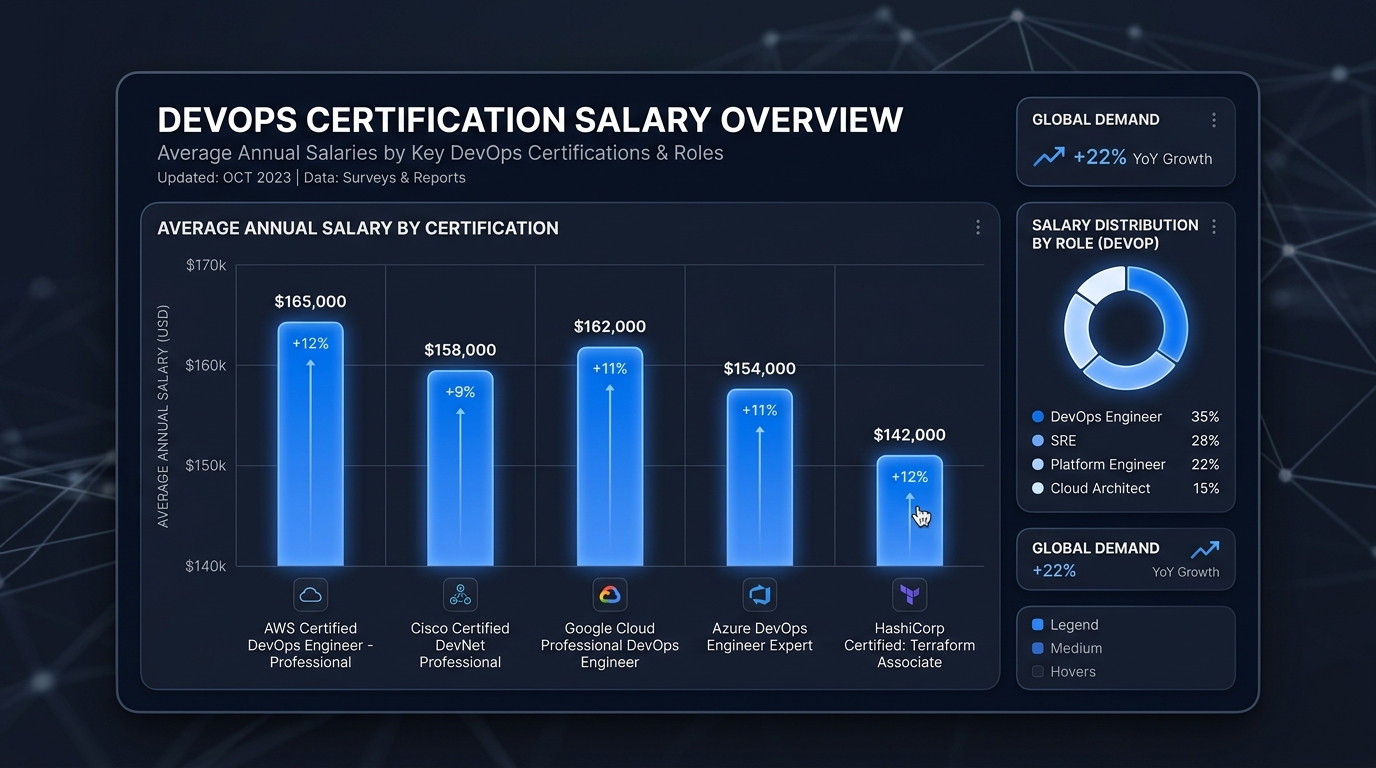
The **salary devops** professionals command in 2026 reflects the massive shift toward autonomous infrastructure. Having an expert-level certification acts as a catalyst for moving into elite salary brackets.
💡 Career Tip
In 2026, the highest salaries go to those who combine a platform-level certification (AWS/Azure) with a specialized credential like the CKA.
How to Choose the Right Path
Navigating **devops certifications** requires a strategic approach based on your current role and future aspirations:
- Assess your stack: Match your certification to the cloud provider your organization (or target employer) uses most.
- Focus on containers: Regardless of your cloud choice, the CKA is essential for modern microservices architecture.
- Think about SRE: If you enjoy reliability and observability, the GCP path offers the best SRE-centric curriculum.
Conclusion: Future-Proof Your Career
The investment in your education is the surest way to advance your career in 2026. Whether you choose to master **devops and aws**, specialize in Azure, or go deep into Kubernetes, each step you take builds a foundation for long-term success in the age of Agentic AI.
For organizations looking to build high-velocity engineering teams, professional devops consulting is often the missing piece of the puzzle.
Ready to Automate Your DevOps?
At UseShift, we help organizations implement the advanced automation systems that DevOps engineers manage. Let's discuss your automation roadmap.
Get a Free AI Strategy Session →Key Takeaways
- AWS DevOps Professional remains the top-tier cloud credential for 2026.
- Kubernetes (CKA) is the most sought-after practical certification.
- Certified professionals see an average salary increase of 15-25%.